Automated Palletising in the UK for Faster Output, Safer Handling and Better End-of-Line Control
For manufacturers looking to improve throughput, consistency and workplace safety, Automated Palletising in the UK has become an increasingly practical solution. End-of-line operations can place heavy demands on staff, especially where products need to be stacked quickly, accurately and for long periods of time. Manual palletising often creates bottlenecks, introduces inconsistency and increases the physical strain on operators. Premier Automation helps businesses address those issues with robotic palletising systems designed around real production needs, layout constraints and commercial targets.
Palletising may sit at the end of the process, but it has a direct effect on how the rest of the line performs. If finished products begin to queue because palletising cannot keep up, output across the whole factory can suffer. A reliable automated solution helps maintain flow, reduce stoppages and create a more stable production environment. It also gives businesses more control over load quality, handling standards and long-term labour planning.
Why Automated Palletising in the UK is growing across manufacturing
Manufacturers across the UK are under continued pressure to improve efficiency while maintaining quality and controlling costs. Labour-intensive palletising tasks can be difficult to scale, particularly where demand fluctuates or shift coverage is challenging. Repetitive lifting and stacking can also increase the risk of fatigue and injury, especially in busy production areas.
Robotic palletising offers a dependable alternative. Robots can stack products quickly and consistently, follow repeatable pallet patterns and operate for extended periods with minimal variation in performance. That makes them suitable for a wide range of environments, from food and beverage production to general manufacturing and logistics. Premier Automation works with customers to identify where palletising automation can provide the best return, whether that means a simple single-line cell or a more complex multi-line system integrated with wider end-of-line equipment.
The strongest results usually come when the solution is tailored to the process rather than selected as a standard off-the-shelf package. Product type, pack size, throughput requirements, footprint and future flexibility all need to be considered at the design stage.
What makes a palletising system effective
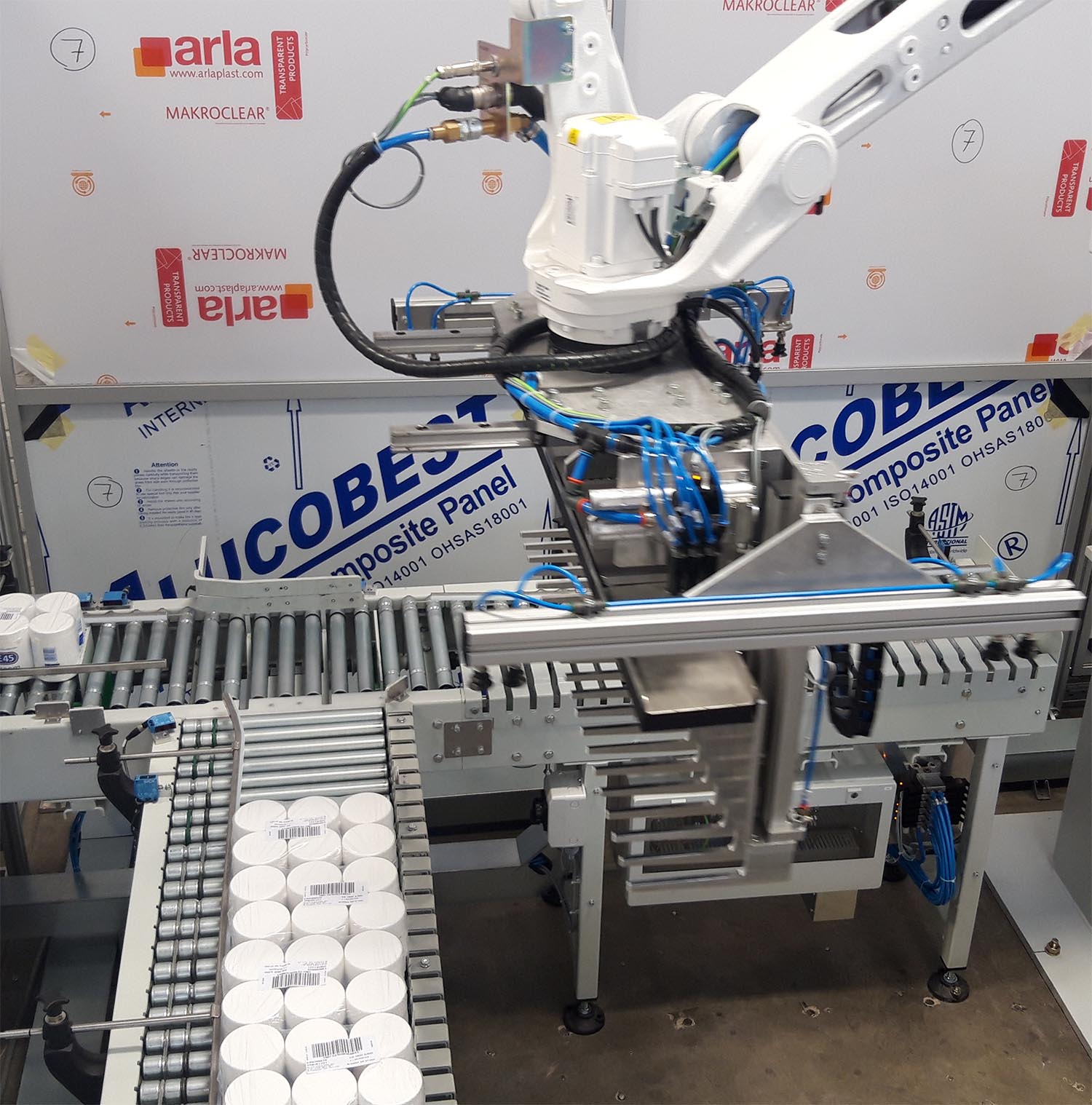
An effective palletising system is about more than the robot alone. It depends on how well the full cell is designed and integrated. Infeed conveyors, product orientation, empty pallet handling, gripper tooling, control systems and guarding all contribute to the final result. If one part of the system is poorly considered, it can reduce the performance of the whole installation.
Gripper design is especially important because different products need different handling methods. Cartons, bags, trays and other packaged goods all behave differently, and the tooling needs to suit their size, weight and stability. Some businesses require a single pallet position, while others need twin pallet stations, multiple infeeds or integration with downstream equipment such as stretch wrappers. Premier Automation has extensive experience designing robotic systems for varied products and production setups, helping customers achieve a robust solution that works in real factory conditions.
Ease of use matters too. Operators should be able to understand and interact with the system without unnecessary complexity. A clear control interface and sensible operating logic make a major difference to daily performance, especially in fast-moving environments.
Planning Automated Palletising in the UK for real factory conditions
Businesses investing in Automated Palletising in the UK need a solution that works in practice, not just in theory. Every site has its own constraints, from floor space and product flow to staffing, access and production schedules. A good automation partner will look at the whole process before recommending a system.
This includes understanding how products arrive at the palletising area, what pallet patterns are needed, how completed loads will leave the cell and whether the solution may need to adapt in future. In some cases, an existing system may be upgraded or re-engineered rather than replaced. In others, a used robot may be integrated into a new application to meet performance and payback targets more cost-effectively.
Premier Automation supports customers with new robot systems, upgrades to existing installations and the integration of used robots where appropriate. The company can also relocate existing systems locally, nationally or internationally, helping manufacturers protect previous investment while improving performance. That flexibility is valuable for businesses whose production needs continue to evolve.
Safety, standards and reliable control
Any automation project needs to be designed with safety in mind from the beginning. Palletising systems must perform efficiently while protecting the people who work around them. Guarding, control logic, safe access and proper risk assessment are all essential parts of a professionally designed cell.
Guidance from the HSE is highly relevant when considering the safe use of machinery and work equipment. Industry insight from BARA also reflects the growing role robotics plays in modern manufacturing. These principles matter because a well-designed palletising system should not only improve output but also create a safer and more controlled working environment.
Premier Automation designs and manufactures control systems for robots, special purpose machinery and process lines, with full schematics, panel layouts, cable schedules, EN13849 safety reports and controls risk assessments. That level of engineering detail helps ensure the finished system is functional, intuitive and built for dependable long-term operation.
Why the right automation partner matters
Successful palletising automation relies on more than equipment supply. It needs design expertise, programming support, mechanical and electrical integration, commissioning and after-sales understanding. Businesses often see better outcomes when one experienced team takes responsibility for the complete solution rather than splitting work across multiple suppliers.
Operating from its facility in Bedford, Premier Automation supports manufacturers with robot integration, control systems, fabrication, tooling, programming and system upgrades. This joined-up approach allows projects to be developed around each customer’s process, commercial goals and practical site requirements.
If your business is reviewing end-of-line performance and looking for a safer, more consistent way to handle finished products, Premier Automation can help. From bespoke robotic cells to upgraded existing systems, their team delivers tailored support for Automated Palletising in the UK, helping manufacturers improve output, reduce manual handling and move forward with greater confidence.