
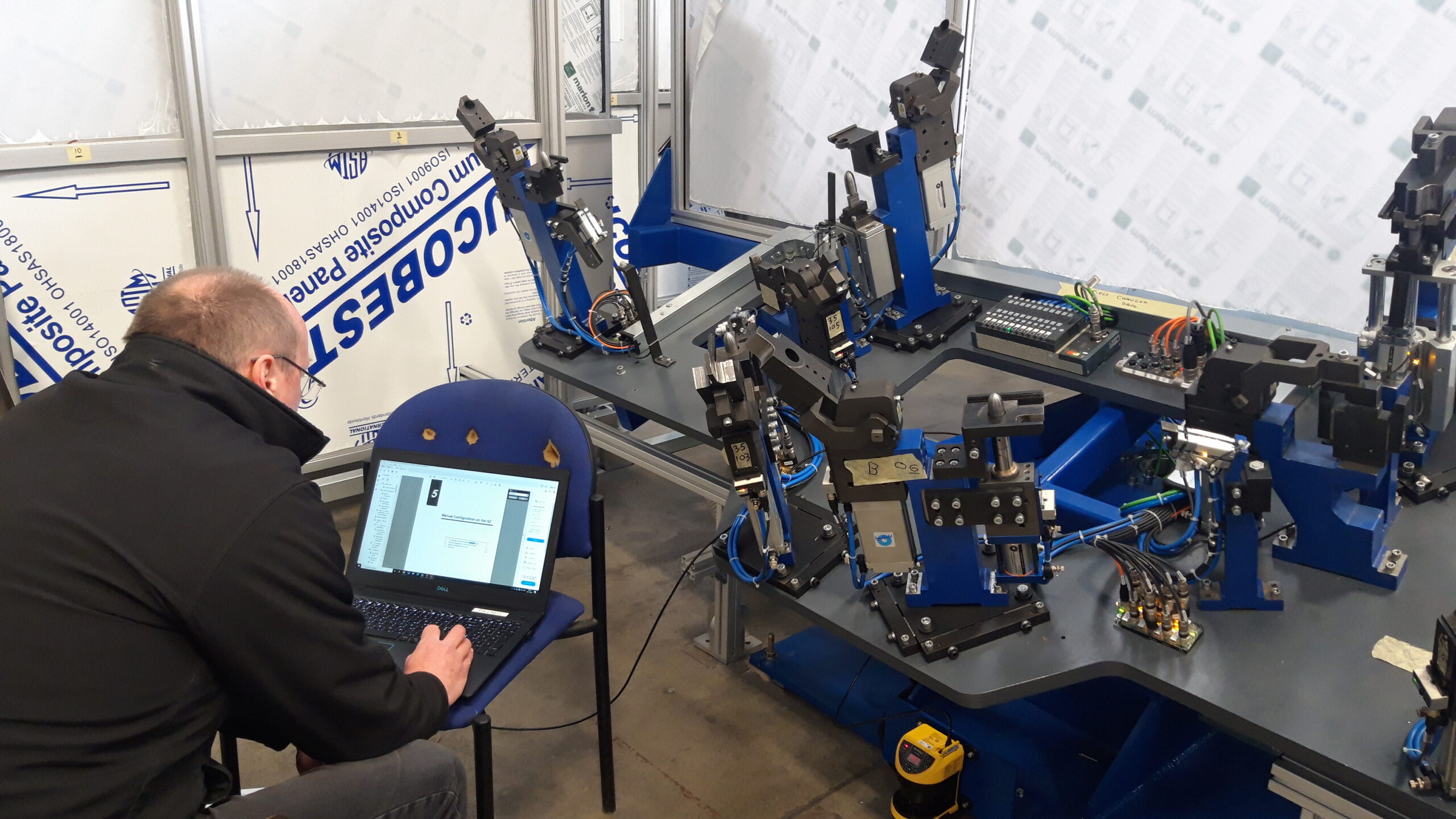
Robot Welding Systems In Bedford: Practical Automation For Better Quality And Output
Robot Welding Systems In Bedford can help manufacturers improve weld consistency, increase production capacity and reduce reliance on repetitive manual processes. For businesses based in Bedford and the surrounding areas, robotic welding is often most effective when it is designed around the real production environment rather than treated as a standard off-the-shelf purchase. Premier Automation supports this approach by designing new robot systems, integrating used robots, upgrading existing automated systems and tailoring each solution to the customer’s process, space, budget and payback criteria.
Welding remains one of the most widely used applications for industrial robots, and for good reason. A well-integrated robotic welding cell can deliver repeatable weld quality, controlled cycle times and improved use of skilled labour. Instead of relying on operators to carry out the same welds repeatedly across long shifts, a robot can perform the process consistently while staff focus on preparation, inspection, quality control and higher-value tasks.
Why Robot Welding Systems In Bedford Are Worth Considering
Many manufacturers reach a point where manual welding alone limits growth. Demand may increase, product tolerances may become tighter, or it may become harder to recruit and retain skilled welders. Robot welding helps address these pressures by creating a more controlled and repeatable process.
For businesses producing batches of similar components, automation can support faster throughput and more reliable output. It can also reduce the variation that naturally occurs between different operators or shift patterns. This is particularly valuable where weld appearance, strength and dimensional accuracy are important to the final product.
Robotic welding is not suitable for every job, and honest assessment matters. Premier Automation provides practical guidance to help customers understand whether automation is commercially and technically sensible. This includes reviewing the component design, fixturing requirements, cycle times, production volumes, access for the robot, safety considerations and expected return on investment.
Designing A Welding Cell Around Your Process
A successful robot welding project starts with the process itself. The robot is only one part of the system. Fixtures, guarding, extraction, control panels, programming, part loading, operator access and safety systems all need to work together. If these elements are not planned properly, the cell may fail to deliver the expected gains.
Premier Automation has experience integrating a wide range of robot models from leading manufacturers, including systems that use different welding technologies. The team can design new cells, integrate used robots where appropriate, and re-engineer existing automation to make it more efficient or suitable for new products. This is useful for companies that already have equipment but need it modified, relocated or upgraded rather than replaced completely.
Control systems also play a major role. The control system needs to be reliable, intuitive and suitable for the wider production environment. From PLC programming to robot programming, operator interfaces and safety reports, each part of the system should support smooth day-to-day operation.
Robot Welding Systems In Bedford For Quality, Safety And Productivity
Consistent weld quality is one of the strongest reasons to consider automation. Once the welding path, parameters and fixturing are correctly set, the robot can repeat the same movement again and again with high accuracy. This helps reduce rework, scrap and quality issues caused by inconsistent technique or fatigue.
There are also safety and welfare benefits. Welding can involve heat, fumes, bright arcs, repetitive movements and awkward working positions. By automating suitable tasks, businesses can reduce manual exposure to some of these conditions. Safety must still be properly designed into the system, including guarding, risk assessment and operator procedures. Guidance from the HSE machinery safety resources is a useful reference for businesses reviewing work equipment and machinery responsibilities.
Productivity gains can come from shorter cycle times, fewer stoppages and more predictable output. Robot Welding Systems In Bedford can also help make better use of skilled welders by moving them away from repetitive production work and into tasks that require judgement, inspection, set-up and technical oversight.
Upgrading Or Re-Engineering Existing Welding Automation
Not every project starts with a blank sheet. Some companies already have robot welding cells that no longer perform as required. The system may be slow, difficult to maintain, unsuitable for a new product, or built around outdated controls. In these cases, upgrading or re-engineering the existing system can be a cost-effective route.
Premier Automation can assess existing systems through a site survey, review the current equipment and discuss what needs to change. This may involve replacing key components, improving tooling, modifying guarding, updating software, reprogramming robot paths or integrating new control systems. Existing robot systems can also be relocated locally, nationally or internationally where a business is moving site or reorganising production space.
Offline programming can also reduce disruption. By creating or editing programmes away from the live production cell, downtime at the point of installation can be reduced. Tools such as Robot Studio and Siemens PLC Sim allow programmes and cell layouts to be developed and tested before final commissioning on site.
Choosing Robot Welding Systems In Bedford With The Right Integration Partner
The quality of the integration partner is just as important as the robot itself. A welding robot needs to be selected, installed and programmed as part of a complete production solution. This means the integrator must understand mechanical design, electrical controls, safety, welding technology, software, manufacturing flow and long-term support.
Industry bodies such as the British Automation & Robot Association can be useful for companies wanting to understand the wider automation sector and the role of robotics in UK manufacturing. However, the final decision should come down to whether the proposed system solves the production problem in a practical, measurable and reliable way.
Premier Automation operates from a large facility in Bedford with strong transport links for access to many parts of the country. The company has in-house machining and fabrication facilities, experienced mechanical and electrical engineers, robot and PLC programmers, and the capability to design, build, install, commission and support complete automation systems.
Planning A System That Delivers Payback
Before investing in automation, manufacturers should consider the expected payback. This includes labour savings, quality improvements, reduced waste, increased capacity, lower downtime and the ability to take on more work. It should also include practical details such as available floor space, part presentation, loading and unloading, maintenance access and operator training.
A good project should be built around clear objectives. These might include improving weld repeatability, increasing production volume, reducing bottlenecks, supporting lights-out operation for suitable processes, or adapting production to new components. The more clearly these goals are defined, the easier it is to design a system that meets both technical and commercial requirements.
Robot Welding Systems In Bedford can be a strong investment where the application is suitable, the cell is properly designed and the integration is handled by an experienced team. For manufacturers reviewing their welding processes, Premier Automation can provide honest advice, practical engineering support and tailored robot automation services to help identify the right solution.