Manual vs Automated Palletising: Which Is Right for Your Production Line?
Manual vs Automated Palletising is a common question for manufacturers, warehouses and production teams that need to move products efficiently from the end of a line onto pallets. The right answer depends on your output, product type, available space, staffing pressures and payback targets. For some businesses, manual palletising remains practical for low-volume or varied work. For others, automation offers a more consistent, safer and more scalable way to handle repetitive stacking tasks.
Premier Automation designs, builds, modifies and integrates robot systems to match individual process requirements. Based in Bedford, the company supports customers across the UK with cost-effective automation solutions, including new palletising cells, cobot palletising systems, upgrades, relocations, robot programming, control systems and after sales support.
Manual vs Automated Palletising: understanding the basic difference
Manual palletising relies on operators lifting, turning, stacking and arranging products by hand. This can work well where volumes are low, product sizes change frequently, or the process is too irregular to justify investment in machinery. It gives teams flexibility, especially where products are light, runs are short and pallet patterns change often.
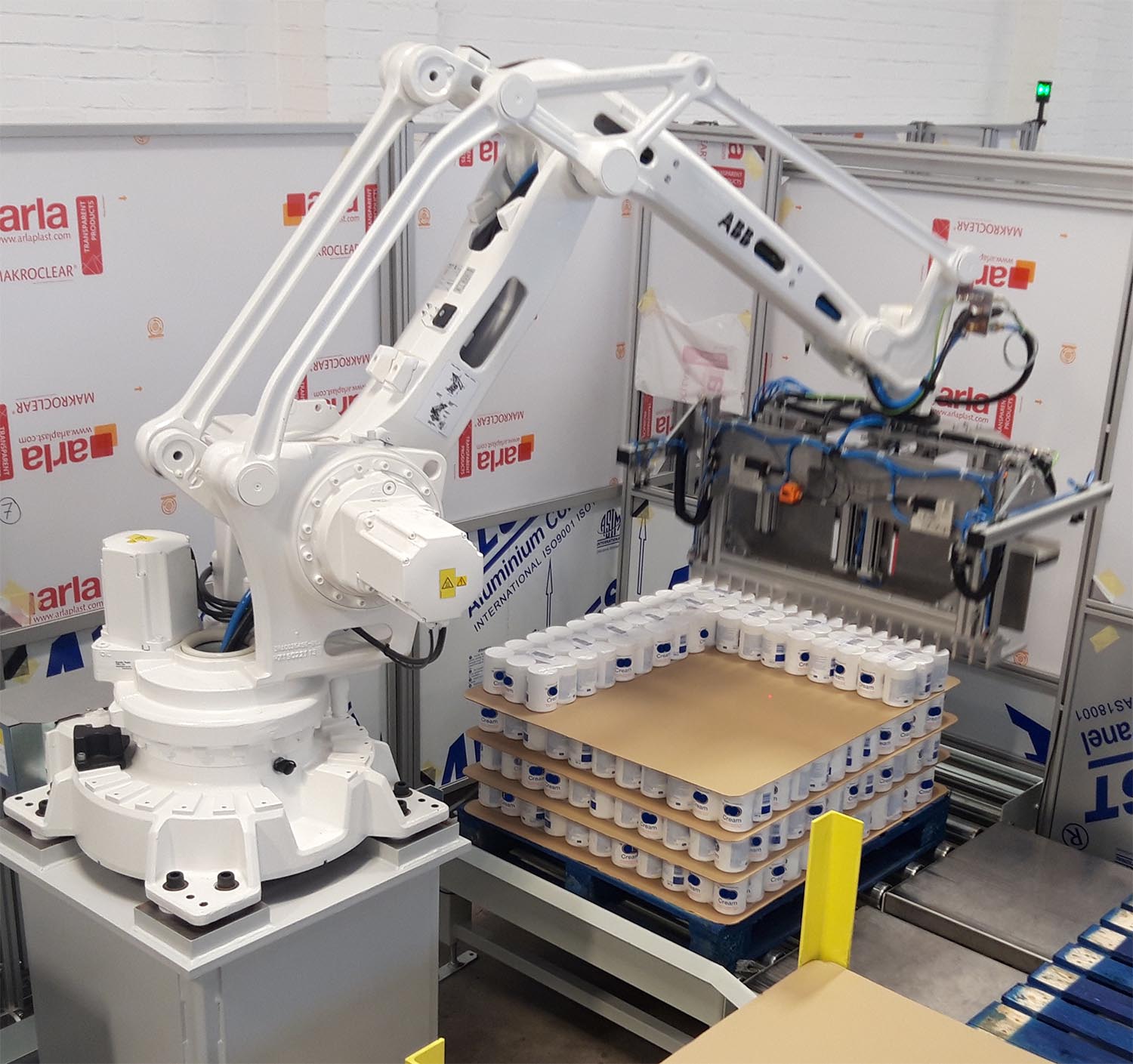
Automated palletising uses a robot or cobot system to pick products from an infeed conveyor and place them accurately onto a pallet. Depending on the layout, the system may handle one line, multiple infeeds, one pallet position or twin pallet positions. It can also be integrated with downstream equipment such as stretch wrappers, pallet conveyors or other handling systems.
For many businesses, the choice is not simply about replacing people with robots. It is about improving the flow of production, reducing manual strain, improving consistency and allowing staff to focus on supervision, quality checks, logistics and other valuable tasks.
Where manual palletising can still make sense
Manual palletising can be suitable for small production volumes, seasonal work, trial products or lines where the product mix changes so often that automation would need frequent reconfiguration. It may also be a sensible short-term option where a business is still assessing demand or planning a future production layout.
The main advantage is low initial cost. There is no robot cell to purchase, no integration work and no new control system to commission. Operators can adjust quickly to unusual product shapes, damaged packaging or last-minute changes in the way pallets are stacked.
However, manual handling has limits. Repetitive lifting can affect productivity, staff availability and workplace wellbeing. As volume grows, businesses may need more operators to maintain output. Errors can also increase during long shifts, especially where products need to be stacked in a precise pattern for stability during transport.
Manual vs Automated Palletising and safety on site
Manual vs Automated Palletising also raises important safety considerations. Lifting cartons, bags, trays or wrapped products repeatedly can increase the risk of fatigue, strains and injuries, particularly where products are heavy, awkward or handled at speed. A well-designed automated system can remove much of this repetitive physical handling from the process.
Automation also needs proper safety design. Guarding, emergency stops, access control, risk assessments and safe operating procedures should be built into the system from the start. The HSE guidance on work equipment and machinery is a useful reference for businesses considering any form of machinery or automation in the workplace.
Premier Automation designs control systems, panel layouts, safety reports and risk assessments as part of its automation projects. This helps ensure that the robot cell is not only productive, but also practical and safe for operators, maintenance teams and production managers.
How automation improves consistency and throughput
Automated palletising is particularly valuable where products are consistent and production runs are regular. A robot can repeat the same movement pattern accurately, shift after shift, without the dips in pace that often occur with manual work. This can reduce cycle times, improve pallet stability and limit product damage caused by rushed or inconsistent handling.
Robotic systems can also support more efficient use of space. A carefully planned pallet pattern can help create stable, uniform loads that are easier to wrap, move and store. For manufacturers handling high volumes, this consistency can make a noticeable difference across transport, storage and dispatch.
The British Automation & Robot Association offers useful insight into the wider role of robotics and automation in UK industry through BARA. For many manufacturers, the key benefit is not simply speed, but a more reliable production process with fewer bottlenecks at the end of the line.
Premier Automation has experience building palletising systems for single and multiple lines, including special grippers for different products. Options can include pre-orienting cartons, multiple infeeds, pallet conveyors and integration with stretch wrapping equipment.
Manual vs Automated Palletising: choosing the right system
Manual vs Automated Palletising should be assessed around real production needs rather than assumptions. A small business with changing product sizes may benefit from a compact cobot palletising cell. A larger manufacturer with steady throughput may need an industrial robot palletising system with twin pallet positions, multiple infeeds or a fully integrated line.
Cobot palletising can be especially useful where space is limited or where flexibility is important. Cobots are often easier to reconfigure for different products or pallet patterns, making them suitable for high-mix production. Industrial robot palletising is generally better suited to higher speeds, heavier products and more demanding continuous operation.
Payback should include more than the initial purchase cost. Businesses should consider labour availability, injury reduction, downtime, product damage, output stability, maintenance needs and future production growth. A properly specified system should meet both technical and commercial criteria, not simply automate for the sake of it.
Premier Automation provides honest advice on whether automation is suitable for a particular application. The team can design a new system, integrate a used robot, update an existing cell, re-engineer older equipment, relocate systems or modify automation to cope with new products and increased throughput.
Frequently Asked Questions
Is automated palletising suitable for small businesses?
Yes, in some cases. A compact cobot palletising system may suit smaller businesses with limited space, moderate throughput and changing product requirements. The best approach depends on product weight, speed, pallet patterns and payback expectations.
Can an existing robot be used for palletising?
Often, yes. If the robot is suitable for the payload, reach and cycle time required, it may be possible to re-engineer or re-programme an existing system for palletising. A site survey is usually the best starting point.
Does automated palletising remove the need for operators?
Not entirely. Operators are still needed for supervision, loading materials, quality checks, maintenance support and managing exceptions. The main benefit is reducing repetitive manual lifting and improving consistency.
How do I know whether manual or automated palletising is better?
The decision should be based on output, product type, labour demands, safety considerations, space, budget and long-term growth plans. Premier Automation can assess your process and recommend a practical palletising solution that fits your production needs.