
How does Automated Palletising work? A practical guide for manufacturers
How does Automated Palletising work? In simple terms, it uses a robot, cobot, or dedicated handling system to pick products from a production line and stack them neatly onto pallets ready for storage, wrapping, or transport. For manufacturers dealing with cartons, trays, bags, boxes, or other repeatable loads, automated palletising can reduce manual handling, improve consistency, and help keep production moving at a steady pace.
For many businesses, palletising is one of the most physically demanding jobs at the end of a production process. It often involves repetitive lifting, twisting, reaching, and stacking. Even when the work is not especially heavy, the repeated movement can affect productivity and staff wellbeing. A well-designed automated system takes on this task while allowing operators to focus on supervision, quality checks, replenishment, and other higher-value work.
Premier Automation designs and builds robotic palletising systems, integrates used robots, upgrades existing automation, and adapts systems to suit individual production requirements. This means the right solution depends on the product, available space, speed, pallet pattern, budget, and payback expectations.
How does Automated Palletising work? The basic process
An automated palletising system usually begins with products arriving on an infeed conveyor. These products may come directly from a packing line, case sealer, labeller, or inspection station. The system controls the flow of items so they arrive in the correct position and orientation for picking.
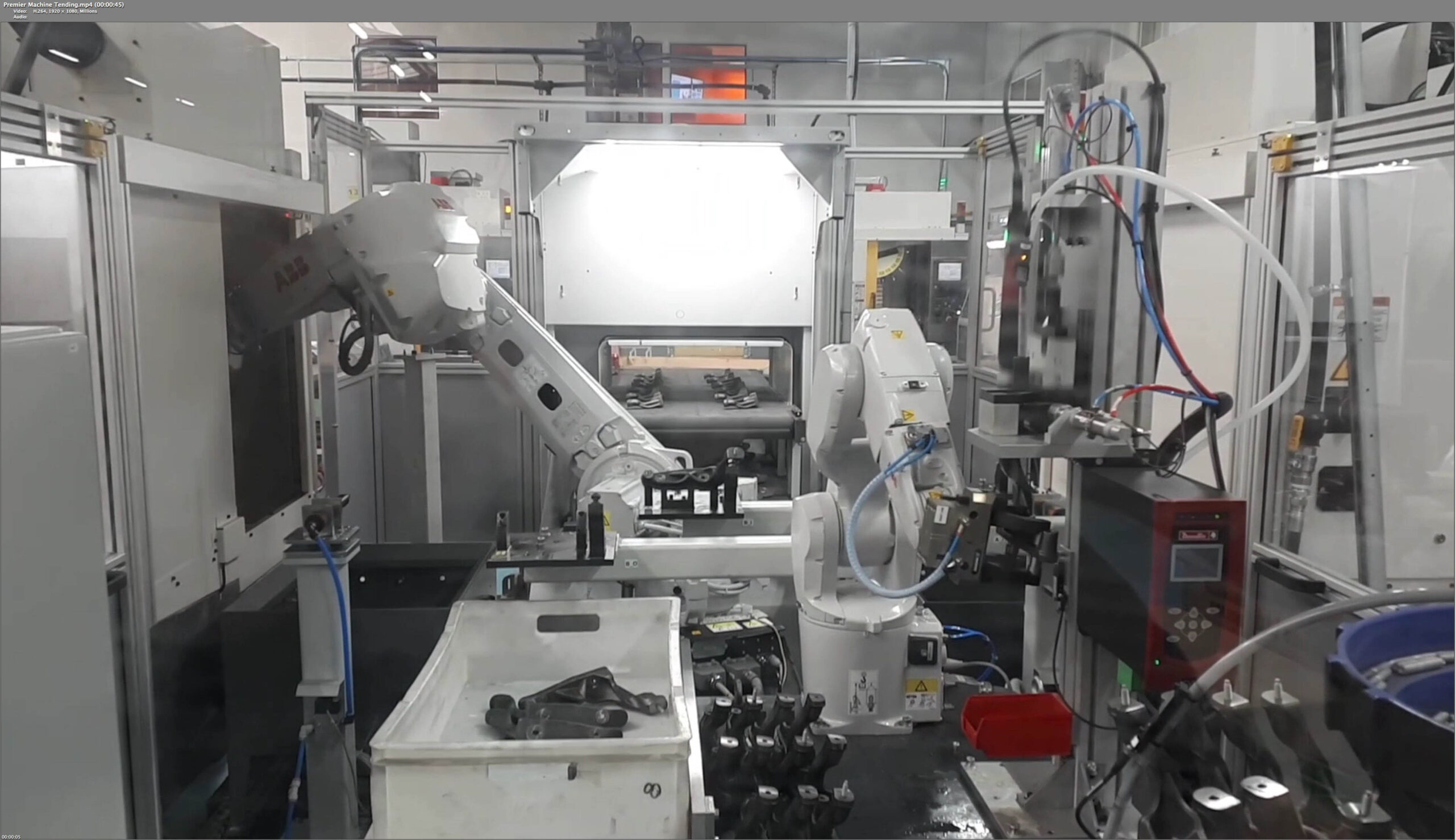
A robot or cobot then collects each product using an end-of-arm tool, often called a gripper. The gripper is designed around the item being handled. It may use vacuum, clamps, forks, mechanical fingers, or a combination of methods. The robot then places the product onto a pallet in a pre-programmed pattern.
As each layer is completed, the robot continues stacking until the full pallet load is built. The finished pallet can then be removed by forklift, pallet conveyor, or another automated handling system. In some installations, palletising is integrated with stretch wrapping so the pallet moves directly from stacking to wrapping with minimal manual input.
Key parts of an automated palletising cell
Although every site is different, most palletising cells include a robot or cobot, an infeed conveyor, guarding or safety equipment, pallet locations, controls, and end-of-arm tooling. Some systems also include empty pallet handling, product orientation, barcode checks, layer sheets, pallet conveyors, or stretch wrapper integration.
The control system is central to the performance of the cell. It manages conveyor movement, robot instructions, safety devices, alarms, pallet selection, and communication with other equipment. Premier Automation also designs and manufactures control systems for industrial applications, including robot systems, process lines, and special purpose machinery.
Safety is planned from the beginning. Automated equipment must be designed, installed, and operated with suitable safeguards, risk assessments, and user training. The HSE guidance on work equipment and machinery is a useful reference for businesses considering automation in a production environment.
How does Automated Palletising work? Robot and cobot options
Traditional industrial robots are often chosen for higher-speed, heavier-duty palletising. They can handle multiple infeed conveyors, larger payloads, and demanding cycle times. A typical robotic palletising cell may use a dedicated palletising robot with one or more pallet positions, allowing the robot to continue working while a completed pallet is removed.
Cobots, or collaborative robots, can be a good option for lower-speed applications, smaller spaces, or production areas where flexibility is a priority. They are often easier to reconfigure for different products and pallet patterns. A cobot palletising cell may suit small and medium-sized manufacturers that need reliable stacking without a large fixed installation.
Premier Automation works with leading robot manufacturers and has experience across single-cell systems, multiple-line palletising, and integrated automation. The business operates from a large facility in Bedford, providing access to customers across the UK.
Choosing the right gripper and pallet pattern
The gripper is one of the most important parts of any palletising system. It must hold the product securely without crushing, marking, dropping, or damaging it. A carton may require a different tool from a bag, tray, tub, bottle pack, or shrink-wrapped bundle. Product weight, surface finish, rigidity, and centre of gravity all affect the design.
The pallet pattern is also critical. A good pattern creates a stable load, uses space efficiently, and suits the product’s shape and strength. Some products need interlocked layers for stability, while others need careful alignment to avoid compression or leaning. Automated systems can store different recipes, allowing operators to select the correct pattern for each product run.
This flexibility is particularly useful where manufacturers handle several carton sizes or seasonal product changes. Rather than relying on manual judgement, the system repeats the same pattern consistently, helping to reduce mistakes and improve pallet quality.
How does Automated Palletising work? From enquiry to installation
The process usually starts with a discussion about the products, throughput, layout, shift pattern, current labour requirements, and future plans. Site surveys help identify the available space, conveyor routes, pallet movement, safety requirements, and any existing equipment that needs to be retained or upgraded.
From there, the system is designed around practical production needs. This may include robot selection, gripper design, pallet flow, guarding, controls, software, and operator access. Offline programming and digital simulation can help test layouts and robot paths before installation, reducing risk and limiting disruption.
Once the system is built, it is tested before delivery where possible. Installation then includes mechanical assembly, electrical wiring, control panel connection, robot programming, commissioning, and operator training. Premier Automation provides robot and PLC programming support, control panel build, installation, commissioning, upgrades, relocation, and after-sales support.
Benefits of automated palletising
Automated palletising can bring several practical benefits. The most obvious is reduced manual handling. Repetitive lifting at the end of a line can be tiring and can increase the risk of strain. By automating the task, manufacturers can improve working conditions and use staff more effectively elsewhere in the process.
Consistency is another major benefit. Robots do not get tired, lose concentration, or vary their stacking technique during a shift. This helps create neater pallets, more stable loads, and fewer handling issues during storage or transport.
Automated palletising can also support higher throughput. A correctly specified robot system can work continuously, keeping pace with production and reducing bottlenecks. For businesses looking to improve efficiency, the British Automation & Robot Association provides useful insight into the wider use of robotics and automation in UK industry.
Cost control is another consideration. While automation requires investment, the payback may come from labour savings, reduced downtime, fewer product handling issues, improved safety, and better use of available space. Premier Automation aims to provide honest, practical advice so customers can understand whether automation is suitable for their process.
How does Automated Palletising work? Is it right for every business?
Automated palletising is not the right answer for every application. It works best where products are repeatable, pallet patterns are clear, and production volume justifies the investment. Very irregular items, unstable products, limited space, or constantly changing requirements may need more detailed assessment before a solution is recommended.
Existing systems can also be upgraded rather than replaced. If a robot cell is becoming inefficient, struggling with new products, or no longer meeting throughput targets, it may be possible to re-engineer the system with new tooling, updated controls, improved programming, or revised safety equipment.
This is where experience matters. Premier Automation can assess current systems, design new robot cells, integrate used robots, modify existing automation, and relocate systems locally, nationally, or internationally where required.
Frequently Asked Questions
How does Automated Palletising work with different box sizes?
Systems can be programmed with different product recipes and pallet patterns. The robot selects the correct movements and stacking layout for each product size, provided the gripper and cell design support those variations.
Can automated palletising be added to an existing production line?
Yes, in many cases it can. The system needs to be designed around the existing line speed, layout, conveyors, safety requirements, and available space. A site survey is usually the best starting point.
Is a robot or cobot better for palletising?
It depends on the application. Industrial robots are usually better for heavier loads and faster speeds, while cobots can suit smaller spaces, lighter products, and flexible lower-speed palletising.
How long does an automated palletising system last?
A well-designed and maintained system can provide many years of service. It may also be upgraded over time with new tooling, controls, programming, or safety improvements as products and production needs change.
For manufacturers considering palletising automation, Premier Automation can help assess the process, explain the practical options, and design a cost-effective system that supports productivity, safety, and long-term performance.