
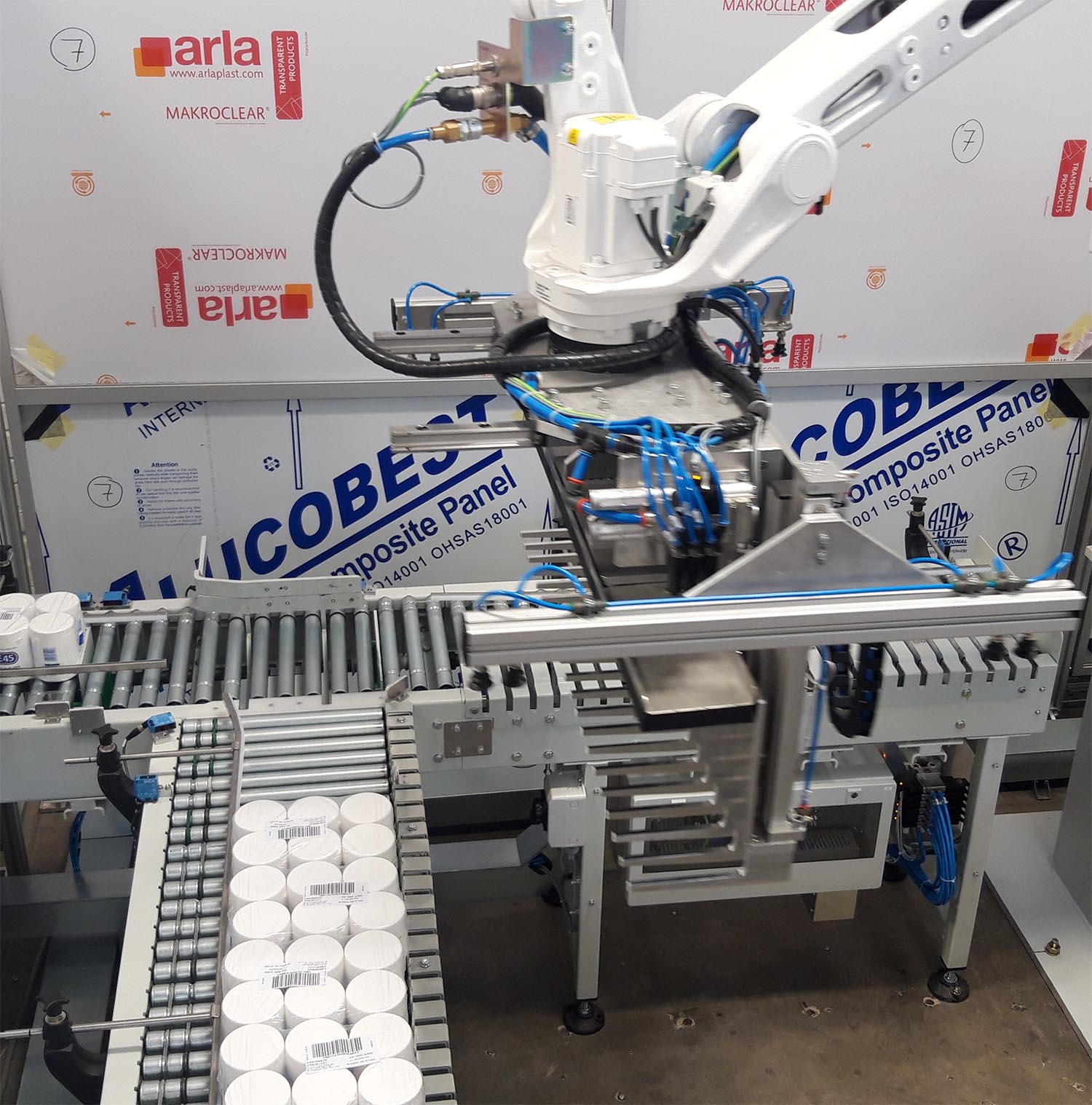
Automated Palletising: A Practical Guide to Safer, Faster Production
Automated Palletising can help manufacturers improve output, reduce manual handling and create more consistent pallet loads. Instead of asking employees to lift, turn and stack cartons or other products repeatedly, a robot system performs the task using a programmed pattern. The result is a controlled process that can keep pace with production while supporting safer working practices and dependable product presentation.
How Automated Palletising Works
A typical system receives products from one or more conveyors, identifies their position and picks them using a purpose-designed gripper. The robot then places each item onto a pallet according to a pre-set stacking pattern. Depending on the application, the system may also handle empty pallets, insert layer sheets, orient cartons or communicate with downstream equipment such as stretch wrappers.
The design should reflect the product, required throughput, available floor space and how pallets enter and leave the area. Cartons, bags, trays, containers and other packaged goods may all require different tooling. A well-designed cell brings these elements together so the process remains reliable without becoming unnecessarily complicated.
Benefits of Automated Palletising
Manual stacking quality can vary during a shift, especially where products are heavy, awkward or handled at speed. A robot follows the same programmed movement and placement position for every cycle. This helps produce stable, repeatable loads that are easier to wrap, store and transport.
Consistency can also reduce avoidable product damage. Accurate placement limits collisions, poor alignment and overhanging cartons. Where several products or pallet patterns are required, recipes can be stored within the control system and selected by an operator. This gives businesses flexibility without relying on staff to remember complex stacking arrangements.
Palletising often involves repetitive lifting, twisting and reaching. Moving these activities into an automated cell can reduce physical strain and allow employees to focus on quality checks, supervision and other useful tasks. The system must still be correctly guarded, assessed and maintained. The HSE guidance on work equipment and machinery provides useful information for businesses responsible for safe equipment use.
Safety measures may include perimeter guarding, interlocked gates, light curtains, safe stopping functions and emergency stops. The correct arrangement depends on the robot, payload, layout and level of operator interaction. Risk assessment should therefore be part of the engineering process from the beginning.
Choosing the Right System for Your Production Line
The best solution is designed around production requirements. A single-line cell may suit a straightforward carton process, while twin pallet positions can allow the robot to continue working as a completed pallet is removed. Multiple infeeds may be useful where several production lines need to share one robot.
Some applications benefit from a traditional industrial robot with high speed and payload capacity. Others may suit a collaborative robot, particularly where products are lighter, volumes are moderate and a compact footprint is valuable. The British Automation and Robot Association provides information about industrial automation through BARA.
Businesses should also consider future product changes. A system that can accept alternative grippers, revised pallet patterns or extra conveyors may offer better long-term value than one designed only for current demand. Controls should be intuitive so operators can select products, view alarms and understand system status without unnecessary complexity.
Before investing, review current labour demands, production rates, shift patterns, downtime and damaged goods. These figures help establish where savings may be achieved and whether the proposed system meets payback criteria. The cheapest design is not always the best choice if it limits throughput, flexibility or maintainability.
Integrating Automated Palletising with Existing Equipment
A palletising robot does not have to operate as an isolated machine. It can be integrated with conveyors, barcode readers, pallet dispensers, vision systems, stretch wrappers and warehouse handling equipment. Connecting these stages can reduce manual transfers and create a smoother route from packed product to finished pallet.
Existing equipment may also be upgraded rather than replaced. Re-engineering a cell can improve cycle times, accommodate new products or reuse a suitable robot in a revised layout. Offline programming and digital simulation can help engineers test movements before installation, reducing disruption during commissioning.
A site survey should confirm floor space, access, utilities, conveyor heights and pallet movements. It should also identify how installation can be planned around production. Systems built and tested off-site can often be commissioned more efficiently, while operator training and clear documentation help the team take ownership once the cell enters service.
Frequently Asked Questions
What products can a palletising robot handle?
Robots can handle cartons, bags, trays, tubs and many other packaged products. The gripper must be designed for the product’s size, weight, surface and handling needs.
Can an existing production line be automated?
Yes. Many systems can be integrated with existing conveyors and machinery. A site assessment will establish what can be retained, modified or replaced.
How much space does a palletising cell need?
The footprint depends on the robot, pallet positions, guarding and product flow. Compact base-frame and cobot options may suit sites where space is restricted.
Can one system handle several products?
Yes, provided the robot, tooling and controls are designed for the required range. Stored recipes can manage different pallet patterns and product formats.
Premier Automation designs new robot cells, integrates used robots and upgrades existing systems to suit individual production and payback requirements. For practical guidance on Automated Palletising, the team can assess your process and recommend a robust, cost-effective approach.