How can Automated Palletising assist me? A Practical Guide for Manufacturers
If you are asking, “How can Automated Palletising assist me?”, the answer usually comes down to safer handling, steadier output and a more reliable end-of-line process. For many manufacturers, palletising is one of those tasks that looks simple but creates pressure on labour, space, consistency and dispatch deadlines. When boxes, bags, trays or wrapped products need stacking all day, small delays and handling errors quickly build into larger production issues.
Automated palletising uses a robot, cobot or dedicated handling system to stack products onto pallets in a controlled and repeatable pattern. It can be designed for single production lines, multiple infeeds, different product sizes and integration with conveyors, pallet dispensers, stretch wrappers and other end-of-line equipment. Premier Automation, based in Bedford, designs and builds robot systems around each customer’s process, rather than expecting every factory to fit a fixed standard package.
How can Automated Palletising assist me? By improving consistency
Manual palletising depends on the speed, strength and attention of individual operators. Even with a skilled team, pallet quality can vary across a shift, particularly when products are heavy, awkward or produced at high volume. Automated palletising helps create consistent stack patterns, stable loads and repeatable placement from the first pallet of the day to the last.
This consistency can reduce product damage during internal movement, storage and transport. It also helps make better use of pallet space, which can improve warehouse handling and loading efficiency. For customers who need predictable output, clear pallet presentation and fewer disruptions at dispatch, automation can make the final stage of production much easier to control.
Reducing manual handling and workplace strain
Palletising often involves repeated lifting, twisting, bending and reaching. Over time, this can place strain on operators, especially where products are heavy or production runs are long. By moving repetitive stacking work to a robot or cobot, businesses can reduce the physical demands placed on their team.
This does not mean removing people from the process completely. In many cases, staff are reassigned to quality checks, machine operation, supervision, replenishment or other higher-value tasks. The goal is to use people where judgement and flexibility are needed, while automation handles the repeated movements that create fatigue and risk.
Businesses considering automation should also think carefully about safe system design, guarding, access, emergency stops and operator training. The HSE guidance on work equipment and machinery is a useful reference point for understanding employer responsibilities around machinery safety.
How can Automated Palletising assist me? By increasing throughput
For growing manufacturers, palletising can become a bottleneck. Production may be capable of running faster, but finished products still need to be stacked, moved and prepared for dispatch. If the end of the line cannot keep up, the whole process is affected.
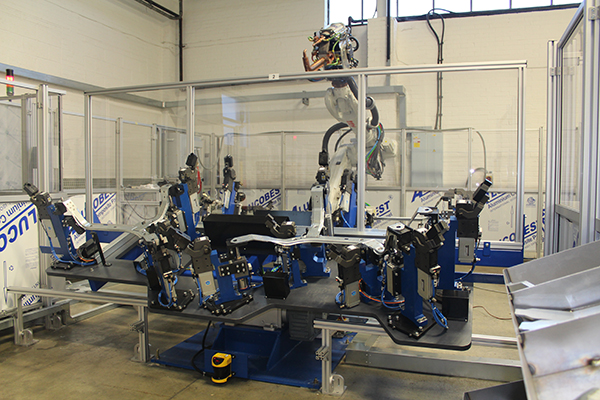
An automated palletising cell can be designed around the required cycle time, product type, pallet layout and available space. For example, a basic palletising cell may handle cartons from a single infeed conveyor onto one pallet position. A twin palletising cell may handle two infeeds and two pallet positions. A cobot palletising cell may provide a compact option for lower payloads, flexible production areas or businesses looking for a more adaptable solution.
Premier Automation has experience designing special grippers for different products and building palletising systems for single and multiple lines. These systems can also be integrated with downstream equipment, such as stretch wrappers, to create a more complete end-of-line solution.
Supporting flexible production and product changes
Many businesses do not run one product forever. Packaging sizes change, production volumes increase, new product ranges are introduced and customer requirements shift. A well-designed palletising system should take this into account from the start.
Robotic palletising is particularly useful where different pallet patterns, product sizes or line layouts need to be considered. The right system can be reprogrammed or modified as the business changes. This is where experienced integration matters. The robot, gripper, conveyor layout, controls and safety systems all need to work together as one practical production tool.
Premier Automation can also modify, upgrade or re-engineer existing automated systems where customers need better performance, shorter cycle times or support for new products. This can help businesses gain more value from equipment they already own, rather than replacing an entire system unnecessarily.
How can Automated Palletising assist me? By using space more effectively
Factory space is valuable. Manual palletising areas can become cluttered with pallets, part-stacked loads, packaging materials and movement routes for forklifts or pallet trucks. This can affect both efficiency and safety.
Automated palletising cells can be designed to suit the available footprint. Some systems are mounted on fabricated base frames, making installation and relocation more straightforward. Options such as pallet conveyors, pallet stacks, multiple infeeds and pre-orientation conveyors can be considered depending on the site layout and product flow.
Cobot palletising may also suit businesses that need a compact and flexible arrangement. Cobots can be easier to reconfigure for different products or pallet patterns, which can be useful for high-mix or lower-volume production. The British Automation & Robot Association provides useful industry context on robotics and automation in the UK.
Choosing the right palletising system
The best palletising system is not always the largest or most complex. It should match the product, speed, space, budget and payback criteria. A small manufacturer may need a simple cobot cell to ease manual handling. A larger production site may require a faster industrial robot with multiple infeeds, pallet positions and integration with wrapping equipment.
Before investing, it is worth reviewing product weights, dimensions, current labour requirements, shift patterns, output targets, pallet patterns, available floor space and future production plans. This helps determine whether automation is suitable and what type of system would provide the best return.
Premier Automation provides honest and unbiased advice to help customers identify the most appropriate solution. The company designs and builds new robot systems, integrates used robots, upgrades existing equipment and supports control system design, PLC programming, robot programming, installation and commissioning.
How can Automated Palletising assist me? By improving long-term reliability
End-of-line reliability affects the whole production process. If finished goods cannot be stacked and moved efficiently, downtime and delays can spread backwards through the line. Automated palletising helps create a planned, repeatable and measurable process, making it easier to manage output and identify improvements.
For some businesses, the biggest benefit is speed. For others, it is reduced manual handling, better pallet quality, improved safety or the ability to run with fewer interruptions. The strongest results usually come from designing the system around real production needs, rather than treating palletising as a one-size-fits-all task.
Frequently Asked Questions
Can automated palletising handle different product sizes?
Yes, many systems can be designed to handle different product sizes, pallet patterns and production lines. The gripper, programming and infeed arrangement need to be specified correctly for the products being handled.
Is automated palletising only suitable for large factories?
No. While high-volume factories often benefit from industrial robot palletising, smaller manufacturers may benefit from cobot palletising or compact cells designed around lower throughput and limited space.
Can an existing robot system be upgraded for palletising?
In some cases, yes. Existing systems can often be assessed, re-engineered, reprogrammed or modified to improve performance, reduce cycle times or support new products.
How do I know if palletising automation is worth the investment?
A site assessment can help review labour demands, product handling, cycle times, safety considerations, space and expected payback. Premier Automation can support this process by reviewing your production requirements and recommending a practical automation solution.