Improving Workplace Safety with Robotics: Practical Automation Strategies for Safer, Smarter Manufacturing
Improving Workplace Safety with Robotics is no longer a “nice to have” for UK manufacturers. It is a practical way to reduce injuries, improve consistency, and keep production moving when labour is tight or tasks are physically demanding. From palletising and machine tending to welding, gluing, and collaborative applications, robotics can remove people from the most hazardous, repetitive, and ergonomically challenging work while maintaining quality and throughput.
At Premier Automation, we design and build new robot systems, integrate used robots, and modify or update existing automation to meet specific process requirements and payback criteria. Founded in 2000, we have developed into one of the UK’s leading suppliers of robot-based automation and control systems. Our team supports projects from concept through to commissioning and training, with honest, unbiased advice to ensure automation is genuinely suitable for your application.
Below is a practical guide to how robotics improves safety, where it delivers the biggest impact, and how to implement systems that are robust, compliant, and easy to operate.
Improving Workplace Safety with Robotics by Reducing Manual Handling and Repetitive Strain
A large proportion of workplace injuries come from manual handling and repetitive motion. Lifting, twisting, bending, pushing, pulling, and repeating the same movement for hours each day creates long-term risk, even when loads are not extreme. Robotics targets these problems directly by taking over the repetitive, high-frequency actions that wear people down over time.
Common safety wins include:
- Palletising and depalletising to remove repeated lifting and stacking
- Machine tending to reduce awkward postures and repetitive loading cycles
- Conveyor pick-and-place to minimise reach, twist, and speed pressure
- Packaging and end-of-line tasks where fatigue can lead to mistakes
Robotic palletising offers a good example. A correctly designed cell stacks consistently without fatigue, reduces product damage, and removes the strain of repetitive lifting. It also improves the predictability of the process, which helps reduce the small errors that can lead to trips, knocks, and near-misses.
Premier Automation designs palletising systems for single and multiple lines, including integrated solutions with conveyors and downstream equipment. We also develop special grippers to suit different products, ensuring safe handling and stable loads.
Improving Workplace Safety with Robotics Through Guarding, Safety Integration and Control Systems
Safe automation is not just about the robot. It is about the complete system design, including guarding, sensors, safety-rated controls, interlocks, risk assessments, and compliant documentation. A well-engineered cell should make it difficult to do the wrong thing, while keeping operation intuitive for the people who use it.
Key elements of safe robot integration include:
- Correct machine guarding and perimeter protection where needed
- Safety scanners, light curtains, interlocked gates, and emergency stops
- Clear safe zones and defined access points for maintenance
- Safety-rated control systems designed to relevant standards
- Commissioning, validation, and operator training so everyone understands the risks
Premier Automation specialises in designing and manufacturing new control systems for a wide range of industrial applications, whether for robots, special purpose machinery, or process lines. We deliver full schematics, parts lists, panel layouts, cable schedules, EN13849 safety reports, and controls risk assessments. As a Siemens Solution Partner, we take pride in building systems with intuitive interfaces that operators can use confidently.
We build control panels in-house, fully test them before despatch, and ensure compliance with relevant British and European standards and directives. This attention to detail supports both safety and uptime.
Improving Workplace Safety with Robotics in Hazardous Processes Like Welding and Dispensing
Some manufacturing processes carry inherent hazards: heat, fumes, sparks, sharp edges, chemicals, and high-energy equipment. Welding remains one of the most common industrial robot applications for good reason. A robot can repeat a precise weld path consistently, while removing people from direct exposure to heat, fumes, and arc flash. The safety benefit is immediate, and quality often improves at the same time.
Robots are also well suited to gluing, gasket dispensing, and applying complex beads. These tasks can involve hazardous materials, awkward orientations, and a need for consistent application. Robotic application improves repeatability and reduces human exposure, particularly where two-part epoxies or other specialist materials are involved.
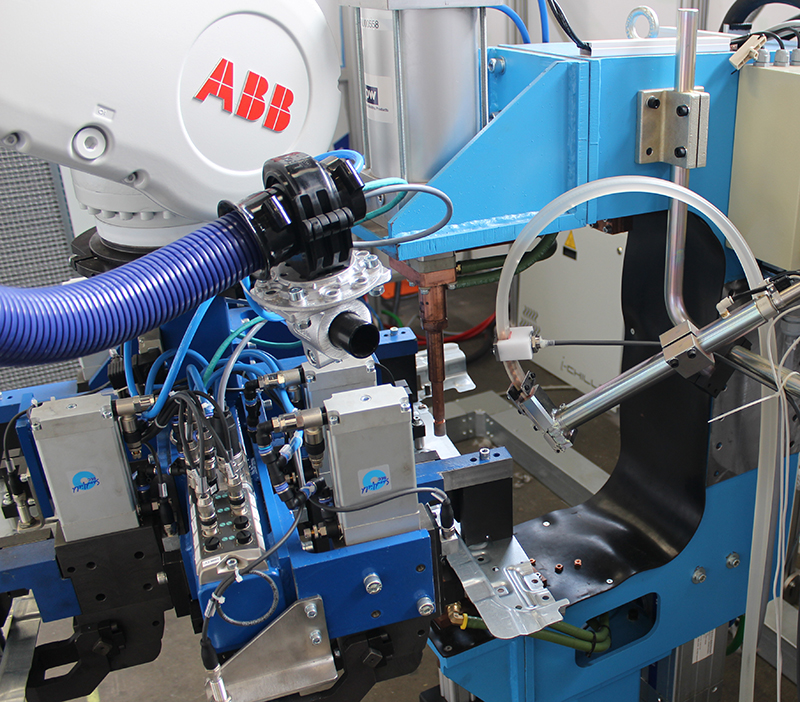
Premier Automation has built systems integrating a wide range of welding technologies and has delivered multiple dispensing applications using different application methods. Where appropriate, we can use off-line programming tools to prove paths and reduce on-site downtime, making commissioning safer and more efficient.
Collaborative Robots and Safe Human-Robot Working
Collaborative robots, or cobots, can support Improving Workplace Safety with Robotics by working alongside people for tasks that are repetitive or awkward, while keeping the workspace flexible. Cobots use force limiting and advanced sensing, helping reduce risk when sharing a working area. They can be a strong fit for high-mix, low-volume operations where quick changeovers matter.
Cobots are commonly used for:
- Packing and palletising where loads are suitable for collaborative payloads
- Machine loading and unloading where space is limited
- Simple assembly and inspection tasks
- Flexible cells that need frequent reconfiguration
It is important to be clear: a cobot is not automatically safe in every situation. The full application must still be assessed properly, and safety integration is still required. The benefit is that cobots can often be deployed with less disruption to an existing workspace, supporting gradual automation without major infrastructure changes.
Premier Automation has developed a range of standard machine tool loading cells, designed to integrate with multiple machine tool platforms. We are experienced in machine tool interfaces, gripper design, and safety integration, helping customers implement solutions that improve both safety and productivity.
Upgrades, Relocation and Re-Engineering Existing Systems for Safer Performance
Many businesses already have automation in place, but safety and efficiency expectations evolve. Guarding standards change, products change, and older equipment can become unreliable. Upgrading or re-engineering existing robot systems can deliver major safety benefits without starting from scratch.
Reasons to upgrade include:
- Worn components causing performance issues and unsafe behaviour
- Process changes requiring new tooling, guarding, or programming
- Increased throughput targets leading to rushed manual intervention
- The need to improve interfaces and reduce operator error
Premier Automation provides site surveys to assess existing systems, and we can modify, upgrade, or relocate automation locally, nationally, or internationally. We also support new tooling manufacture, fabrications such as pedestals and frames, and the assembly and wiring of components to get your system running safely and reliably.
Safer Manufacturing Starts With the Right Advice
Improving Workplace Safety with Robotics works best when safety is treated as a design requirement, not an add-on. The right system reduces manual handling, removes people from hazardous processes, and uses proper safety integration to protect operators and maintenance teams. It also supports quality, productivity, and long-term competitiveness.
Premier Automation provides honest and unbiased advice to guide you to the most appropriate solution. If you want to explore how robotics could reduce risk in your operation, we welcome the opportunity to review your process, identify the best-fit approach, and design an automation solution that is robust, compliant, and cost effective.