Faster throughput, safer handling, smarter automation
Modern warehouses and distribution centres are under constant pressure to move more stock, reduce handling risk, and improve accuracy while keeping labour and energy costs under control. Palletising and Depalletising Systems for Warehouses are a proven way to achieve those goals, especially where output is high, product ranges are changing, or manual handling is becoming harder to resource reliably. From inbound unloading through to outbound despatch, automated pallet handling can transform productivity, safety and consistency.
Premier Automation designs and builds new robot systems, integrates used robots, and modifies or updates existing automated systems to meet individual process requirements and payback criteria. Founded in 2000, we’ve developed into one of the UK’s leading suppliers of robot-based automation and control systems, operating from our large Bedford facility with excellent transport links. We provide honest, unbiased advice to guide customers to the most appropriate solution, and we back it up with design, build, installation, commissioning, programming, and after-sales support.
Palletising and Depalletising Systems for Warehouses: what they are and where they fit
At a practical level, palletising is the automated stacking of cases, bags, trays, or products onto pallets in a stable pattern ready for storage or transport. Depalletising is the reverse process, removing items from pallets and feeding them into conveyors, picking stations, or production lines. Palletising and Depalletising Systems for Warehouses can be configured for single or multiple lines, different pallet sizes, varying product types, and different levels of integration with peripherals such as conveyors, wrappers, pallet dispensers, and pallet conveyors.
These systems typically sit at key points of warehouse flow:
- End of line, where packed goods need stacking for despatch
- Goods-in, where pallets need breaking down for put-away or picking
- Mixed handling areas, where different SKUs and patterns are required across shifts
- Buffer zones, where consistent pallet quality reduces damage and improves storage density
Because warehouses rarely stand still, flexibility is essential. The most effective solutions are designed to accommodate new products, changing throughput, and evolving operational needs without forcing a complete rebuild.
Palletising and Depalletising Systems for Warehouses that improve safety and consistency
Manual pallet handling is physically demanding and repetitive. Over time it increases the risk of musculoskeletal injuries and fatigue-related mistakes. It also introduces variability in pallet build quality, which can lead to unstable loads, damaged goods, and wasted space in racking or transport. Palletising and Depalletising Systems for Warehouses reduce those issues by delivering consistent stacking patterns, repeatable cycle times, and controlled handling.
Automation also improves quality in ways that aren’t always obvious at first. Stable loads reduce wrap usage, product damage, and claims. Predictable pallet build height can improve trailer fill and storage planning. And consistent infeed and outfeed speeds help downstream operations run more smoothly.
Premier Automation has designed special grippers for many different products, allowing automated handling to be adapted to cartons, bags, trays and other formats. With the right tooling and integration, systems can maintain gentle handling for delicate packaging while still meeting demanding throughput targets.
Palletising and Depalletising Systems for Warehouses: robots, cobots and cell design choices
There’s no single “best” approach to automation. The right choice depends on throughput, footprint, product variability, and how you want people and machines to work together. Palletising and Depalletising Systems for Warehouses can be built around industrial robots for high speed, or collaborative robots (cobots) where flexibility and ease of integration are key.
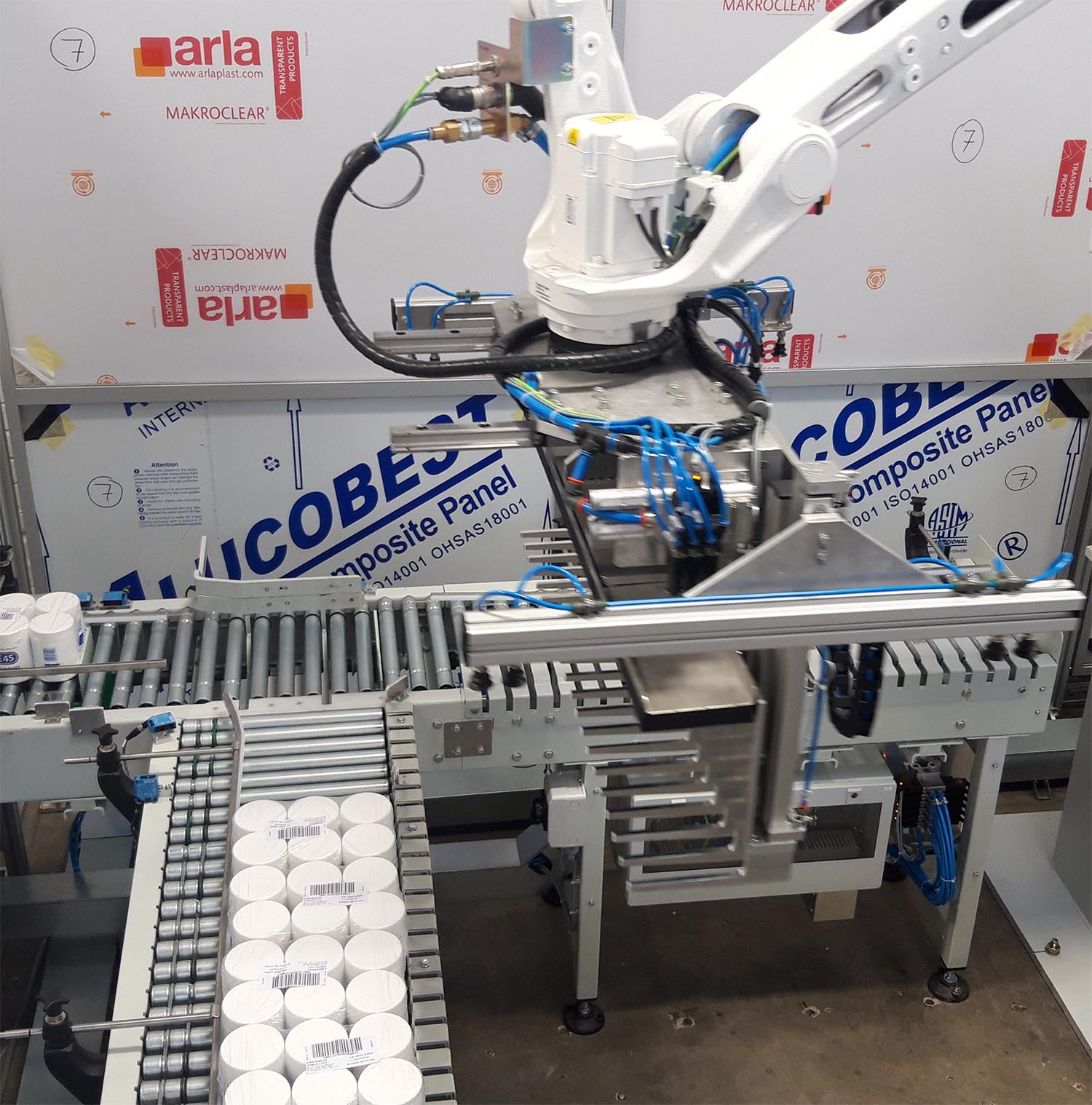
Industrial robot palletising cells are ideal where outputs are high and continuous. A classic example is a single infeed conveyor feeding cartons to a pallet position, with the robot stacking consistently at speed. Where two lines feed the same area, twin palletising cells can palletise on two separate pallet positions with strong utilisation of robot time.
Cobots, on the other hand, are increasingly popular for high-mix, lower-volume operations or where quick changeovers matter. They’re easier to programme, easier to reconfigure for new patterns, and their compact footprint can suit existing warehouse layouts where space is at a premium. A cobot palletising cell can handle one infeed with two pallet locations, or palletise to a pallet conveyor for smoother material flow.
The key is matching technology to the job. Premier Automation will provide honest and unbiased advice so your investment solves the right problem and delivers the expected payback.
Controls, integration and uptime: making automation work in the real world
A palletising cell is only as good as its controls and integration. Palletising and Depalletising Systems for Warehouses need to communicate reliably with conveyors, sensors, safety systems, wrappers, and sometimes higher-level software such as WMS, MES or SCADA. The control system is the heart of automation, and it must be highly functional while remaining intuitive for operators.
Premier Automation specialises in designing and manufacturing new control systems for a wide range of industrial applications, including robots, special purpose machinery and process lines. We are proud to be a Siemens Solution Partner, and our design work is executed in the latest Eplan platform. We can deliver full schematics, parts lists, panel layouts, cable schedules, EN13849 safety reports and controls risk assessments, supporting both performance and compliance.
All panel build is carried out internally by fully qualified electricians, with full workshop testing prior to despatch. Our engineers then install and commission systems on site, testing power supplies, inputs and outputs, and commissioning software with training included where required. This end-to-end approach reduces project risk and improves long-term reliability.
Upgrades, relocations and re-engineering: protecting your investment
Warehouses change. Product types shift, packaging formats evolve, and throughput targets move. That is why many customers need their existing automation modified rather than replaced. Premier Automation offers upgrades and relocation services that help keep systems effective as requirements change. Palletising and Depalletising Systems for Warehouses can often be re-engineered to reduce cycle times, improve efficiency, or accommodate new products without starting from scratch.
If you have an existing robot system you’re considering modifying, upgrading or relocating, the first stage is a site survey. We assess the system, discuss your requirements, and recommend a practical route forward. We can also relocate systems within an existing facility, to another UK site, or internationally if required, making the transition as swift and risk-free as possible.
Our in-house machining and fabrication facilities also support rapid delivery of components, including robot pedestals, support frames, machine guarding and spreader plates. That capability is particularly valuable when lead times matter and downtime must be minimised.
Programming and digital twin: faster commissioning, less disruption
Programming has a huge impact on system performance and uptime. Premier Automation provides robot and PLC programming support across a wide range of systems, from modifications to existing programmes through to Industry 4.0 digital twin development. Using tools such as Robot Studio and Siemens PLC Sim, we can create and edit programmes offline, reducing disruption during commissioning and speeding up the path to stable production.
Off-line programming also allows optimisation before manufacture, helping confirm reach, cycle time, pallet patterns, and safety zones early. That results in smoother installation, fewer unexpected changes on site, and better return on investment.
Choosing the right partner for warehouse pallet handling automation
Pallet handling automation can deliver major gains, but only if it is designed around your reality: your products, your volumes, your people, and your space. Premier Automation combines robot integration experience, control system expertise, honest consultancy, and strong after-sales support to deliver robust, reliable solutions.
If you’re exploring Palletising and Depalletising Systems for Warehouses, we welcome the opportunity to discuss your challenges and help you identify the right solution. Whether you need a new cell, an upgrade, a relocation, or a re-engineered system to meet new throughput requirements, our engineering team will work closely with you to create an efficient, cost-effective installation that performs day after day.