
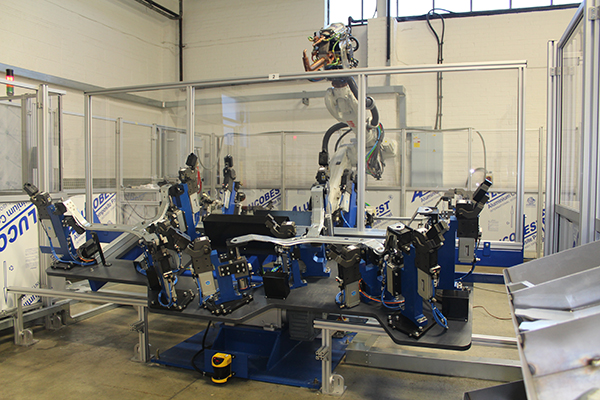
Shaving seconds off a cycle is valuable, but only if the cell runs consistently, recovers quickly from minor stops, and keeps people safe during operation and maintenance. That is why Robot Cell Design in Bedford is best approached as a complete production system, not just a robot and a guarding layout. At Premier Automation, we design and build new robot systems, integrate used robots, and re-engineer existing automation to reduce cycle time while protecting uptime, quality, and operator safety.
Manufacturers often find that “cycle time” losses are not caused by robot speed alone. The real delays come from part presentation that is inconsistent, machine handshakes that include unnecessary waits, changeovers that take too long, or safety systems that create nuisance trips. A well-designed cell removes those hidden inefficiencies and ensures the fastest possible running speed is also the most stable.
Robot Cell Design in Bedford starts with the process
The best-performing cells begin with a clear definition of the production problem. Before selecting robot size, reach, or brand, the process must be mapped end to end: what happens upstream, what the robot must do, what the machine tool or line must do, and where an operator needs access.
A proper specification phase typically covers:
- Target throughput, takt time, and quality requirements
- Product mix, likely future variants, and how changeovers will be handled
- Part presentation method (fixtures, pallets, conveyors, bins, AMRs)
- Critical interfaces to machines, sensors, and any shopfloor systems
- Maintenance access needs and safe intervention points
- Payback criteria and what “success” looks like in production
Premier Automation was founded in 2000 and has grown into one of the UK’s leading suppliers of robot-based automation and control systems. We aim to provide cost-effective solutions that meet technical and commercial needs, and we will be honest about where automation fits and where it does not. That early clarity is often what prevents expensive redesign later.
Robot Cell Design in Bedford: layout and material flow
Once the process is defined, layout becomes one of the biggest levers for cycle time and reliability. A robot can only move as fast as the cell allows. Poor access, long travel paths, awkward approach angles, and congested part flow can add seconds to every cycle and minutes to every recovery.
Key design principles that cut cycle time safely include:
Short, direct robot paths
Placing pick and place points to minimise reach and rotation reduces motion time and improves repeatability. It also lowers wear on mechanical components over the life of the cell.
Stable part presentation
Many stoppages come from variation in how parts arrive. If parts are tilted, nested, misaligned, or inconsistent, the robot slows down, retries, or faults. Designing fixtures, pallets, conveyors, or vision guidance as part of the core solution is essential.
Efficient machine tool interfaces
In machine tending applications, the handshake between robot and machine can introduce avoidable waits. Premier Automation has extensive experience with machine tool interfaces and standard loading cell approaches, including pallet loaded, conveyor fed, pallet conveyor fed, and AMR-loaded concepts. The right interface strategy reduces idle time and improves recovery after minor stops.
Practical guarding and access
Overly restrictive guarding can slow production through constant stops for access, while poor access increases downtime when something does go wrong. Designing clear access routes, sensible door positions, and safe clearing procedures helps reduce mean time to recover, which is often as important as raw cycle time.
To keep delivery swift and cost-effective, we also have in-house machining and fabrication facilities. That means we can produce items such as robot pedestals, support frames, spreader plates, and guarding elements, and we can react quickly when new tooling parts are needed due to damage or product change.
Controls, safety and programming
Controls are the heart of a robot cell. Even a well-built mechanical solution can underperform if the control system is confusing, difficult to diagnose, or prone to nuisance faults. Premier Automation designs and manufactures new control systems for a wide range of industrial applications, including robots, special purpose machinery, and process lines.
We are proud to be a Siemens Solution Partner. That supports a consistent approach to robust control design and intuitive operator interfaces. In practice, good controls engineering helps to:
- Reduce fault-finding time with clear alarms and structured diagnostics
- Improve consistency between shifts with predictable operating modes
- Prevent recurring issues through sensible interlocks and recovery steps
- Support compliance with appropriate safety standards and documentation
Design is executed in the latest Eplan platform and can include full schematics, parts lists, panel layouts, cable schedules, EN13849 safety reports, and controls risk assessments. Panel build is carried out internally by qualified electricians, and panels are fully tested in our workshop prior to despatch.
Programming is another major driver of cycle time. Premier Automation provides PLC and robot programming support across a comprehensive range of systems, from single-cell installations to complex automation incorporating multiple peripheral technologies. Where appropriate, we use off-line tools such as Robot Studio and Siemens PLC Sim to develop and refine programmes away from the production line, minimising downtime at installation and supporting safer commissioning.
For manufacturers with existing automation, upgrading does not need to mean starting again. We offer system assessment, re-engineering, and upgrade work to restore performance, reduce cycle times, or accommodate new products. We can also relocate systems within a facility, across the UK, or internationally, managing the move in a controlled, risk-reduced way.
Choosing the right partner for Robot Cell Design in Bedford
Cycle time improvements are only valuable when they are sustainable. The right cell design delivers speed, yes, but also stable uptime, safe interventions, and straightforward operation. With established experience across applications such as machine tending, palletising, welding, and dispensing, plus in-house controls, fabrication, and commissioning capability, Premier Automation delivers complete solutions built around real production needs.
If you are planning a new cell, improving an older installation, or relocating existing automation, Robot Cell Design in Bedford with Premier Automation can help you reduce cycle time safely while keeping the bigger goals in view: higher uptime, consistent quality, and a faster return on investment.