
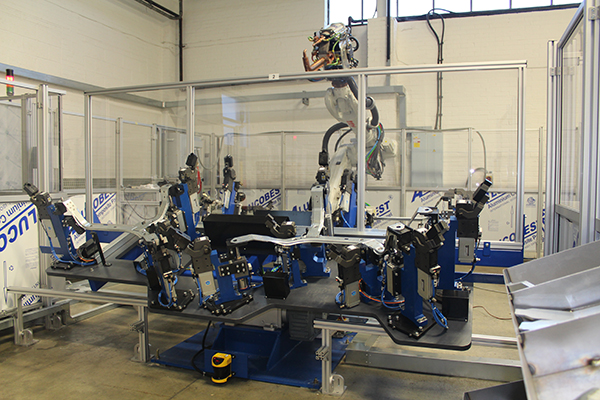
Automated loading systems are a proven way to remove manual handling, reduce bottlenecks, and stabilise production flow. In UK manufacturing, loading tasks often sit at the heart of efficiency problems: inconsistent feeding to machines, downtime caused by operator availability, and quality variation caused by fatigue or rushed changeovers.
An automated loading system is designed to deliver parts or products to a process in a controlled, repeatable way. That process could be a CNC machine, press, injection moulding line, conveyor, inspection station, case packer, palletiser, or warehouse handling point.
At Premier Automation, we design and integrate automated loading systems in the UK that match real operating conditions: product variation, limited space, strict safety requirements, and the need for quick changeovers. This guide explains the main types of automated loading, where they are used, how to specify them, and how to build a strong business case.
What is an automated loading system?
An automated loading system is a combination of equipment, controls, and safety measures that feeds items into a machine or process without continuous manual intervention. Depending on the application, it may involve robotics, conveyors, elevators, indexing mechanisms, or dedicated handling tooling.
A typical automated loading system may include:
- Infeed conveyors or accumulation buffers
- Part presentation and orientation (singulation, spacing, and alignment)
- Robotic or mechanical pick-and-place loading
- Sensors for detection, verification, and jam prevention
- PLC/HMI controls with recipe management and diagnostics
- Safety guarding, interlocks, and risk-assessed access
- Interfaces to upstream and downstream equipment
The objective is to keep the process fed, minimise stoppages, and ensure consistent positioning every cycle.
Why automated loading is increasingly important in the UK
Loading tasks are often underestimated because they look simple. In practice, they create many of the problems that reduce OEE (Overall Equipment Effectiveness): micro-stops, misfeeds, inconsistent cycle times, and safety incidents.
Automated loading systems in the UK are typically adopted to achieve:
- Reduced manual handling and lower injury risk
- Stable machine utilisation and fewer idle periods
- Higher throughput without proportional labour increases
- Improved part positioning for better quality
- Better traceability through sensors and data capture
- More resilient output during labour constraints
If your line stops because someone is not available to load, you do not have a machine problem. You have a loading problem.
Common types of automated loading systems
The right solution depends on the item being loaded, the required cycle time, and how predictable the product flow is. Below are the most common approaches.
1) Robotic loading systems
Robotic loaders use an industrial robot (or cobot in suitable applications) with a gripper to pick parts and place them into a machine or fixture. They are chosen for flexibility, SKU variation, and future-proofing.
Common applications:
- CNC machine loading and unloading
- Press tending
- Injection moulding part removal and loading to secondary processes
- Assembly feeding and placement
- Tray loading, case loading, and line transfer
Robotics are ideal when you need repeatable positioning and the option to adapt to new products later.
2) Conveyor-based loading and buffering
In many environments, the “loading system” is primarily a controlled conveyor arrangement with accumulation, indexing, and spacing control. This approach can deliver strong results without a robot, especially when products are uniform and orientation is already correct.
Common applications:
- Feeding cartons or trays into case packers
- Controlled infeed to palletisers
- Staging products for inspection or labelling
- Buffering between variable-speed processes
The value comes from controlling product flow so downstream equipment never starves or floods.
3) Bowl feeders and part presentation systems
For smaller components, automated loading often relies on part feeding and orientation. Bowl feeders, linear feeders, and escapements can present parts consistently for pick-and-place or direct loading.
Common applications:
- Fasteners and small component supply
- Assembly stations requiring oriented parts
- High-speed repetitive placement
These systems are highly effective but need careful design to handle part variation and maintain reliability.
4) Gantry and Cartesian loading systems
Gantry loaders use linear axes to move parts in X/Y/Z, often at high speed and with excellent positional repeatability. They can be cost-effective for defined pick-and-place movements and are common where the working envelope is predictable.
Common applications:
- High-speed loading into fixtures
- Sheet handling and placement
- Repetitive transfer tasks in a controlled area
5) Automated pallet and container loading
Some applications require loading products into pallets, stillages, crates, or bins as part of end-of-line or intralogistics. This may be robotic or mechanical depending on product and speed.
Common applications:
- Automated bin loading for warehousing
- Case stacking into stillages
- Layer forming and pallet build preparation
Key benefits of automated loading systems
1) Increased throughput and machine utilisation
Machines only make money when they run. Automated loading reduces idle time and can remove a persistent bottleneck, especially on multi-shift operations.
2) Reduced manual handling risk and improved safety
Loading often involves repeated lifting, reaching, and interaction with moving equipment. Automation reduces exposure and supports safer operating procedures.
3) Improved quality through consistent placement
Correct positioning is essential for many processes. Automated loading improves repeatability, reducing scrap, rework, and downstream rejects.
4) More predictable costs and scalable output
As production volumes grow, manual loading scales linearly with headcount. Automation can scale output without the same proportional labour increase.
5) Better data and traceability
Sensors and control systems can capture cycle counts, downtime reasons, and verification data. This supports continuous improvement and audit requirements.
How to specify an automated loading system correctly
Most automation issues occur because requirements are unclear at the start. For automated loading systems in the UK, you will get a better outcome if you define the following early.
Product data
- Dimensions, weight, surface finish, and rigidity
- Orientation requirements
- Tolerances and acceptable placement error
- Packaging state (loose, in trays, in cases)
Throughput and duty cycle
- Required cycle time and peak demand
- Shifts per day and annual operating hours
- Upstream variability and downtime expectations
Infeed conditions
- How parts arrive (random, aligned, stacked, in totes)
- Whether singulation or spacing is required
- Buffering needs to smooth upstream variability
Changeovers and recipes
- Number of SKUs and changeover frequency
- Tooling change requirements
- HMI recipe selection and access controls
Integration and safety
- Interfaces to existing machines (signals, fieldbus, interlocks)
- Guarding layout, access routes, and risk assessment requirements
- Fault handling, jam detection, and safe recovery procedures
The best systems are engineered for recoverability. When something goes wrong, operators must be able to return to production quickly and safely.
Typical applications in UK manufacturing
Automated loading is used across many sectors, including:
- Food and beverage (controlled product loading to packing lines)
- FMCG (carton and case loading, line feeding and buffering)
- Automotive and engineering (CNC and press tending)
- Electronics (component feeding and placement)
- Packaging operations (loading to wrappers, case packers, palletisers)
- Warehousing and 3PL (bin/tote handling and transfer systems)
If a task is repetitive and measurable, it is a strong candidate for automated loading.
Common pitfalls and how to avoid them
- Ignoring part presentation: robots and mechanisms need consistent pick conditions.
- Underestimating changeovers: frequent SKU changes demand recipe control and adaptable tooling.
- Insufficient buffering: if upstream is variable, you need accumulation to protect machine utilisation.
- Poor fault recovery design: fast recovery procedures matter as much as cycle time.
- Safety retrofits late in the project: design guarding and access early to avoid layout rework.
A strong integrator will validate assumptions early and prototype or simulate key risk areas where needed.
FAQs
What is the difference between automated loading and machine tending?
Automated loading focuses on feeding items into a process. Machine tending often includes both loading and unloading, plus cycle coordination, inspection, and part tracking.
Do automated loading systems work with multiple products?
Yes, with the right design. The key is recipe-driven control and tooling that can handle variation without complex manual adjustment.
Is a robot always required?
No. Many loading challenges are solved with controlled conveyors, indexing, and part presentation. Robotics is chosen when flexibility and positioning accuracy are priorities.
How do we estimate ROI?
Start with the true cost of downtime, labour, scrap, and overtime. Then model throughput improvement and risk reduction. Accurate data makes ROI clearer.
How do we start a project?
Gather product details, line speeds, shift patterns, and a layout of the loading area. A concept design can then define scope, safety approach, and integration points.
Why Premier Automation
Premier Automation designs and integrates automated loading systems in the UK that reduce manual handling and stabilise production. We focus on reliable part presentation, safe operation, clear operator workflows, and maintainable controls.
If you want to explore automated loading for your line, we can help you identify the best approach, define the scope, and build a practical business case.