What is an Automated Palletiser? A Practical Guide for Manufacturers
What is an Automated Palletiser? For many manufacturers, warehouses and production facilities, it is the system that takes finished products from a conveyor or process line and stacks them neatly onto pallets, ready for wrapping, storage or transport. Instead of relying on manual lifting and repetitive stacking, an automated palletiser uses robotics, conveyors, controls and tooling to complete the task accurately, consistently and safely.
For businesses handling cartons, boxes, trays, sacks or other packaged goods, palletising can be one of the most physically demanding stages of production. It often involves repeated lifting, twisting and positioning, which can slow output and increase the risk of workplace injuries. An automated palletising system is designed to remove much of that manual strain while helping production lines run more smoothly.
Premier Automation designs and builds robot systems, integrates used robots and updates existing automated systems to suit individual processes, production requirements and payback criteria. From its facility in Bedford, the company supports manufacturers across the UK with practical, cost-effective automation solutions.
What is an Automated Palletiser? The Basic Principle
An automated palletiser is a machine or robotic cell that arranges products onto a pallet in a set pattern. Products usually arrive on an infeed conveyor. The system then positions, lifts or grips the items before placing them onto the pallet layer by layer. Once the pallet is complete, it can be moved on for wrapping, labelling, storage or dispatch.
The system can be designed around different production needs. Some lines may require a single infeed and one pallet position. Others may need multiple product infeeds, twin pallet locations, automatic pallet dispensing, pre-orientation of cartons or integration with downstream equipment such as stretch wrappers.
Robotic palletising is especially flexible because the robot can be programmed to handle different pallet patterns, product sizes and production changes. This makes it suitable for businesses that need reliable output without locking themselves into one fixed process.
What is an Automated Palletiser? Key Components Explained
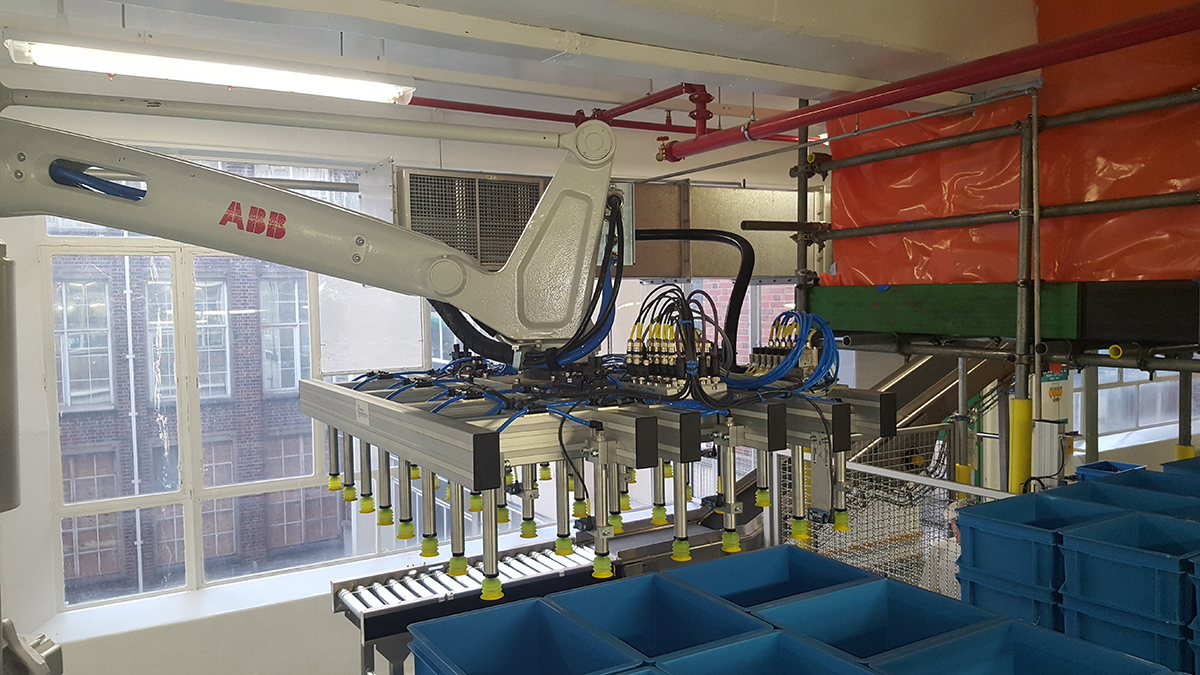
A typical automated palletising system includes several important elements. The robot or mechanical handling unit performs the lifting and placing. The gripper or end-of-arm tooling is designed around the product being handled. Conveyors move products into the cell and may also transport completed pallets away from the system.
The control system is the heart of the installation. It coordinates the robot, conveyors, safety systems, sensors and any connected machinery. A well-designed control system should be reliable, easy for operators to use and capable of communicating with other factory equipment where needed.
Premier Automation specialises in robot integration and control systems, including PLC and robot programming. The company is experienced with a wide range of robot models from leading manufacturers and has ABB Value Provider status, recognising its integration, programming and training capabilities.
Safety is also a key part of any automated system. Guarding, risk assessments, safety circuits and operator interfaces must be carefully considered. The HSE guidance on work equipment and machinery provides useful information for employers responsible for safe machinery use.
Benefits for Production Lines
The main benefit of an automated palletiser is consistency. Manual stacking can vary from person to person, especially during long shifts or when products are heavy, awkward or fast-moving. A robot can repeat the same movement pattern with accuracy, helping to create stable pallet loads and reducing the chance of product damage.
Automation can also improve throughput. Where manual palletising becomes a bottleneck, a correctly designed system can help the line maintain a steady pace. This is particularly valuable for manufacturers dealing with high-volume packaging, end-of-line handling or extended production hours.
Another major advantage is worker safety. Repetitive lifting can contribute to fatigue and injury. By automating palletising, staff can be moved away from physically demanding tasks and into roles that involve supervision, quality checks, line management or other higher-value activities.
For growing manufacturers, automation can also support better labour planning. Rather than relying on extra manual labour to keep up with demand, a palletising system can provide predictable output and reduce pressure on the workforce.
Choosing the Right Automated Palletiser for Your Products
The right system depends on the product, production speed, factory layout and commercial goal. Cartons may require a different gripper from trays, bags or delicate products. Some applications need a compact cobot palletising cell, while others need an industrial robot with higher speed, reach or payload capacity.
A basic palletising cell may be ideal for a single product line with a straightforward stacking requirement. A twin palletising cell may suit businesses that need two pallet positions to reduce stoppages. A cobot palletising cell can be useful where flexibility, footprint and ease of reconfiguration are priorities.
Premier Automation has experience designing special grippers for many different products and building systems for single and multiple lines. Its palletising solutions can also be integrated with equipment such as stretch wrappers to create a more complete end-of-line process.
Industry bodies such as the British Automation & Robot Association also highlight the wider role of robotics and automation in improving productivity, competitiveness and manufacturing performance.
How Premier Automation Supports Palletising Projects
Every production line is different, so a palletising project should start with a detailed understanding of the process. Product size, weight, packaging strength, required pallet pattern, line speed, available floor space and future product changes all need to be considered before a system is specified.
Premier Automation provides honest and practical advice on whether automation is suitable for a specific application. The company can design and build new robot systems, integrate used robots, modify existing systems and re-engineer older installations to improve efficiency, reduce cycle times or handle new products.
Its services also include control system design, panel build, installation, commissioning, PLC programming, robot programming, offline programming and after-sales support. For existing automation, the team can assess, upgrade or relocate systems locally, nationally or internationally.
This makes What is an Automated Palletiser? a useful question for any business reviewing labour costs, end-of-line performance, safety risks or future production capacity. The answer is not just a piece of equipment; it is a tailored system designed around real products, real operators and real commercial targets.
For manufacturers considering robotic palletising, cobot palletising, control system upgrades or a complete automated production solution, Premier Automation can help assess the requirement and develop a robust system that supports productivity, safety and long-term value.