What is Robotic Welding? A Practical Guide for UK Manufacturers
What is Robotic Welding? For many manufacturers, it means using an industrial robot to carry out repeatable welding tasks with accuracy, consistency and speed. Instead of relying solely on manual welding for every joint, a robotic system follows a programmed path, controls the welding process and produces the same result across large batches or repeated production runs.
For customers, the main point is not the robot itself. It is the improvement it can bring to production. A well-designed robotic welding system can help reduce cycle times, improve weld consistency, support safer working practices and make better use of skilled labour. It can also help manufacturers cope with increased demand without simply adding more manual stations.
Premier Automation designs, builds, modifies and integrates robot systems around each customer’s process. That includes new systems, used robot integration, system upgrades, control systems, tooling, guarding, programming and relocation where required.
What is Robotic Welding? The basic idea
Robotic welding uses a robot arm, welding equipment, fixtures, controls and safety systems to complete a welding task automatically. The robot is programmed to move the torch along a set path, while the system controls key welding parameters such as speed, position and repeatability.
It is commonly used for applications where parts are made repeatedly and require consistent weld quality. This can include metal frames, brackets, assemblies, fabricated components and products used across automotive, engineering, manufacturing and industrial sectors.
Robotic welding is not a one-size-fits-all answer. The quality of the final system depends on the part design, joint access, fixtures, production volume, welding process, operator needs and commercial payback. That is why honest assessment matters before investment. Premier Automation helps customers decide whether automation is suitable, rather than recommending a system where it will not provide value.
What is Robotic Welding? Key benefits for manufacturers
The first major benefit is consistency. A robot can repeat the same path again and again, reducing variation between parts. This is useful where weld quality affects product performance, appearance or downstream assembly.
The second benefit is productivity. Robotic welding can reduce cycle times, support longer production runs and help operators focus on preparation, inspection, quality checks and higher-value work. In some cases, it can also support more continuous production, depending on loading, unloading and fixture design.
The third benefit is better use of skilled welders. Skilled welding labour can be hard to recruit and retain. Automation does not remove the need for expertise, but it can help businesses use that expertise more effectively. Experienced staff may move into programming, supervision, quality control, fixture setting or process improvement.
Safety is also a key consideration. Welding involves heat, fumes, sparks, light exposure and manual handling risks. Robotic systems must be designed with suitable guarding, controls and risk assessment. The HSE machinery safety guidance is a useful reference point for businesses reviewing equipment safety responsibilities.
How a robotic welding cell works
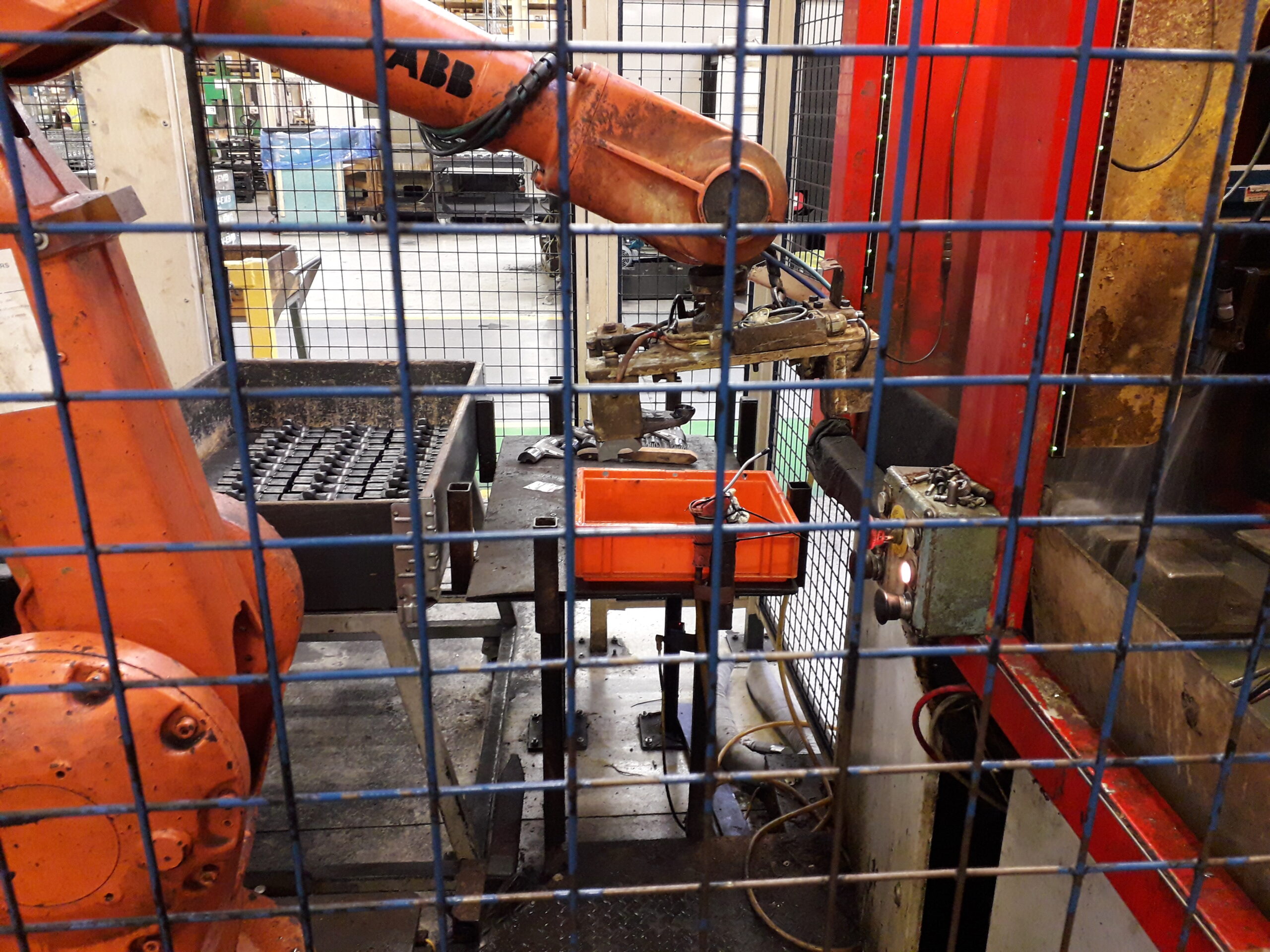
A robotic welding cell usually includes a robot, welding power source, torch, wire feed, fixtures, guarding, extraction considerations, control panel and operator interface. Parts are loaded into the fixture, the robot completes the weld sequence, and the finished component is removed for inspection or the next stage of production.
Fixtures are especially important. A robot can only weld accurately if the part is held accurately. Poor part location, inconsistent gaps or badly designed tooling can affect the quality of the weld. This is where practical engineering experience makes a significant difference.
Premier Automation has in-house machining and fabrication capability, which can support the design and manufacture of tooling, robot pedestals, support frames, guarding and other system components. This helps keep projects practical, robust and aligned with the customer’s production needs.
The control system is also central. A good robotic welding cell should be safe, reliable and straightforward for trained operators to use. Premier Automation designs control systems using modern platforms and provides schematics, parts lists, panel layouts, cable schedules, safety reports and controls risk assessments where required.
What is Robotic Welding? Is it right for your process?
The right starting point is a process review. Some products are ideal for robotic welding, while others may need design changes, improved fixtures or a different production approach before automation makes sense. Important questions include production volume, batch size, part variation, weld access, quality requirements and available floor space.
Payback should also be considered early. Automation should meet both technical and commercial criteria. A system may reduce labour pressure, improve output, reduce rework or support future growth, but those benefits need to be weighed against the cost of equipment, integration, tooling, programming, training and maintenance.
Information from industry bodies such as BARA can help manufacturers understand the wider role of robotics and automation in UK industry. For individual projects, a detailed assessment is still needed because each factory, product and production challenge is different.
Premier Automation operates from a large facility in Bedford and supports customers locally, nationally and internationally. The team can design new robot systems, integrate used robots, update existing automated systems, re-engineer older cells, reduce cycle times and relocate systems when production requirements change.
Planning a successful robotic welding project
A successful project starts with clear objectives. These might include increasing output, improving quality, reducing manual handling, replacing an ageing system, adapting to a new product or improving the efficiency of an existing cell.
Offline programming and simulation can also help. By creating or editing programmes away from the production line, downtime can be reduced during installation or modification. It can also help optimise the cell layout before manufacture, which supports better planning and fewer surprises during commissioning.
Training and support should not be overlooked. Operators need to understand how to use the system safely, load parts correctly, respond to issues and maintain consistent production. After-sales support is also valuable as products change, volumes increase or process improvements are identified.
Premier Automation works with a wide range of robot models and has experience across welding, machine tending, palletising, gluing, dispensing and wider automation systems. This broader integration knowledge is useful because a welding cell often needs to connect with handling, fixtures, controls, safety systems and wider production processes.
Frequently Asked Questions
What types of welding can be automated?
Many repeatable welding tasks can be automated, depending on the material, joint design, access and production volume. A proper review is needed to confirm whether the part is suitable for robotic welding.
Does robotic welding replace skilled welders?
Not necessarily. It often helps skilled staff move into higher-value roles such as programming, inspection, supervision, process control and continuous improvement.
Can an existing robot system be upgraded?
Yes. Existing systems can often be re-engineered, reprogrammed, fitted with new tooling, updated with improved controls or adapted for new products, subject to a site assessment.
How do I know if robotic welding will pay back?
Payback depends on cycle time, labour use, rework levels, quality needs, production volume and future demand. Premier Automation can assess the process and provide practical guidance on the most suitable route.
If you are reviewing welding automation, updating an existing cell or planning a new production system, Premier Automation can help you explore the right solution with clear engineering advice and practical support.