Why is Automated Palletising Useful? A Practical Guide for Manufacturers
Why is Automated Palletising Useful? For many manufacturers, the answer starts with a simple production challenge: finished goods need to be stacked, wrapped and moved quickly, safely and consistently. Manual palletising can work well at low volumes, but as output grows, it often becomes harder to maintain speed, accuracy and staff wellbeing. Automated palletising uses robots, conveyors, grippers and control systems to handle this final stage of production with greater reliability.
Premier Automation designs and builds robot systems, integrates used robots, updates existing automated systems and adapts solutions around each customer’s process, space and payback criteria. With experience across robot integration, control systems, PLC programming, system upgrades and relocation, the company helps manufacturers find practical automation that suits the way they actually work.
Why is Automated Palletising Useful? for daily production pressure
At the end of a production line, delays can quickly affect the whole process. If cartons, bags, boxes or containers are not palletised fast enough, lines may need to slow down or stop. Automated palletising helps keep goods moving by stacking products at a steady rate, shift after shift.
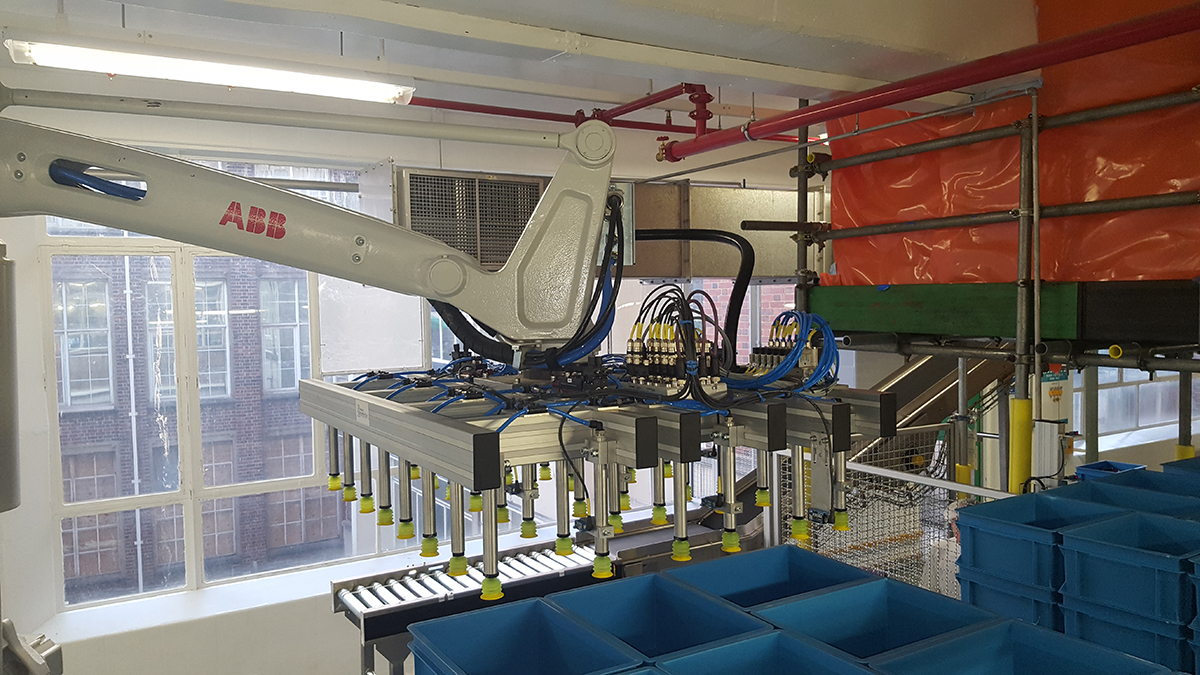
This is particularly useful for businesses handling repeat products, consistent pack sizes or multiple production lines feeding into one despatch area. A robotic palletising cell can be designed for a single infeed, multiple infeeds, twin pallet positions or integration with other equipment such as stretch wrappers. By removing bottlenecks from the end of the line, manufacturers can often improve output without changing the entire production process.
Improving safety and reducing manual handling
Palletising is physically demanding work. Repeated lifting, twisting and stacking can place strain on backs, shoulders and joints, especially where products are heavy, awkward or handled at speed. Automation reduces the need for staff to carry out repetitive manual lifting throughout the day.
This does not remove the need for good workplace safety planning. Any automated system must be correctly guarded, risk assessed and designed around safe operation. The HSE machinery safety guidance gives useful information on work equipment and machinery responsibilities. A well-designed palletising system should support both productivity and safer working conditions.
For customers, this can mean fewer manual handling concerns, a more comfortable working environment and a better use of skilled staff. Operators can focus on checks, line management, quality control and other higher-value tasks instead of repetitive stacking.
Why is Automated Palletising Useful? for consistency and load quality
Consistent pallet loads matter. Poorly stacked pallets can cause product damage, unstable loads, wasted space and problems during transport. Automated palletising can follow a set stacking pattern with repeatable accuracy, helping each pallet meet the required layout, height and stability.
This is useful for manufacturers sending goods to warehouses, retailers, distribution centres or export customers where pallet quality matters. Robots can be programmed to handle different layer patterns, product orientations and pallet sizes. Grippers can also be designed around the product, whether that involves cartons, trays, tubs, bags or other packaging types.
Premier Automation has designed specialist grippers for many different products and built systems for single and multiple lines. This matters because the success of a palletising system depends on more than the robot alone. The infeed, pallet position, guarding, gripper, controls and downstream equipment all need to work as one reliable process.
Matching automation to the right application
Automation is not suitable for every process, and a good solution should start with honest assessment. Product size, weight, line speed, available floor space, pallet patterns, packaging quality and future production plans all affect whether automated palletising will deliver a worthwhile return.
Premier Automation operates from a large facility in Bedford and supports customers across the UK with robot-based automation and control systems. The team can design new systems, integrate used robots, re-engineer existing cells or relocate automation locally, nationally or internationally. This flexibility is valuable for manufacturers who want to improve performance without always starting again from scratch.
For some sites, a traditional industrial robot may be the best choice. For others, a cobot palletising cell may offer the right balance of compact footprint, flexibility and ease of reconfiguration. The British Automation & Robot Association is a useful authority for understanding the wider role of robotics and automation in UK industry.
Why is Automated Palletising Useful? when production changes
Production requirements rarely stay the same forever. New products, new packaging, higher throughput targets or layout changes can all affect the end of line. Automated palletising can be built with flexibility in mind, allowing manufacturers to adapt pallet patterns, product handling and line arrangements as requirements develop.
This is where programming and controls expertise becomes especially important. Premier Automation provides robot and PLC programming support, including offline programming and digital twin work to reduce downtime during design, testing and modification. Existing robot systems can also be re-engineered to reduce cycle times, handle new products or improve efficiency.
For businesses already using automation, upgrading an older system may deliver strong value. A site survey can identify whether parts of the system can be reused, whether tooling needs to change, or whether updated controls and programming could improve performance.
What to consider before investing
Before choosing a palletising system, manufacturers should look at the full process rather than the robot alone. Key considerations include product dimensions, weight, packaging strength, line speed, pallet size, available operators, shift patterns, safety requirements and the space around the line.
Payback should also be realistic. Savings may come from reduced manual handling, improved throughput, less product damage, better use of labour, fewer stoppages and more consistent pallet quality. However, the right answer depends on the specific production environment.
Premier Automation aims to provide cost-effective solutions that meet both technical and commercial criteria. By understanding the process in detail, the team can advise whether a new robotic palletising cell, cobot palletising system, control upgrade or re-engineered existing system is the most suitable route.
Frequently Asked Questions
Can automated palletising work with different product sizes?
Yes, many systems can be designed to handle different product sizes, weights and pallet patterns. The design must consider the product, gripper, infeed and required changeover process.
Is robotic palletising only for large factories?
No. While high-volume sites often benefit, smaller manufacturers may also find value in compact or cobot palletising systems where repetitive stacking is causing delays or manual handling issues.
Can an existing robot be reused for palletising?
In some cases, yes. An existing robot may be suitable if it has the right reach, payload, condition and control compatibility. A proper assessment is needed before deciding.
How do I know if palletising automation is worth it?
The best starting point is a review of your current process, labour demands, output targets, space and commercial goals. Premier Automation can assess your requirements and explain Why is Automated Palletising Useful? for your specific production setup, then recommend a practical solution based on its robot integration, control system and automation services.