Robot Integration In London for Smarter, More Flexible Manufacturing
For manufacturers in London looking to improve output, reduce downtime and create more consistent production, Robot Integration In London can be a practical step forward. Automation is not about replacing every manual task. It is about identifying the right parts of your process to improve, then designing a system that delivers measurable value. Premier Automation helps businesses assess, design, build and upgrade robot systems that suit real production goals, whether that means a brand-new installation, a modification to an existing cell or the relocation of equipment to another site.
Why manufacturers are investing in automation
Businesses across food production, automotive, engineering, packaging and other sectors are under pressure to improve efficiency while maintaining quality. Labour shortages, rising costs and growing customer expectations all play a part. A well-integrated robotic system can help tackle these challenges by increasing throughput, improving repeatability and supporting safer working conditions.
Robots can be used for a wide range of tasks, including palletising, welding, gluing, gasket dispensing, machine tending and material handling. In many cases, they can also support lights-out manufacturing, helping companies make better use of available production hours. Guidance from the HSE on machinery safety also highlights the importance of well-designed, compliant systems, especially where automated equipment operates alongside people.
When Robot Integration In London makes sense for a business
Not every production line needs a robot, and not every problem should be solved with automation. The best results come from taking a detailed look at your process first. That includes cycle times, product variations, available floor space, operator involvement, changeover needs and expected return on investment.
This is where experience matters. Premier Automation provides honest, practical advice based on technical and commercial requirements. Sometimes the right option is a completely new cell. In other cases, an existing system can be re-engineered to improve performance, reduce cycle times or handle a revised product design. There are also situations where a used robot can be integrated into a fresh application, helping control costs while still delivering strong performance.
For many businesses, the value of automation lies in flexibility as much as speed. A modern system can be designed to work with current products while allowing room for future changes, reducing the chance of an expensive replacement further down the line.
Applications that benefit from Robot Integration In London
Robot systems can be tailored to suit very different industries and production environments. Machine tending is one strong example, where robots load and unload CNC machines or other equipment with consistent timing and accuracy. This reduces idle time and supports safer handling of repetitive tasks.
Palletising is another common application. Robotic palletising systems can handle different pack formats, stacking patterns and line speeds while maintaining a stable load. For businesses handling larger volumes, this can create a clear improvement in both output and workplace safety.
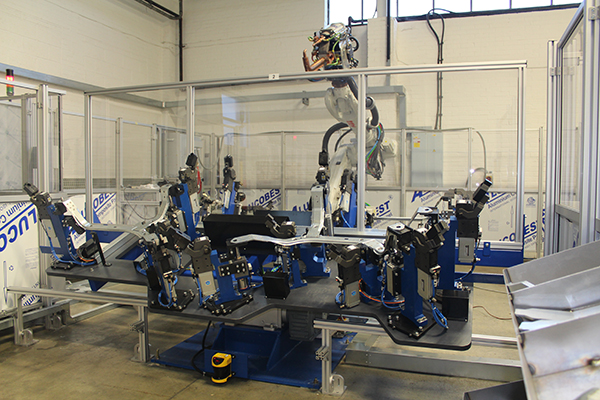
Welding remains a core robotic application too, especially where repeatable quality is essential. Robots can also be used for glue application and gasket dispensing, where accurate path control is critical. Collaborative robots, or cobots, have added another option for companies that need a smaller footprint, easier programming and safe operation alongside staff.
Industry bodies such as the British Automation & Robot Association continue to highlight the growing role of robotics in improving productivity across UK manufacturing. The key is choosing an application where automation supports the wider process rather than creating a new bottleneck.
Choosing the right partner for Robot Integration In London
A successful automation project depends on more than the robot itself. Control systems, guarding, tooling, programming, commissioning and after-sales support all need to work together. Premier Automation has built its reputation on delivering complete, cost-effective solutions that match each customer’s process requirements and payback criteria.
Founded in 2000 and operating from a large facility in Bedford, the company works with a wide range of robot models from leading manufacturers and has experience across diverse applications. Its team designs and builds control systems in-house, produces full schematics and safety documentation, carries out panel builds internally and manages installation and commissioning on site.
That end-to-end approach helps customers avoid the disruption that can come from dealing with multiple suppliers. It also makes it easier to manage future changes, whether that means software updates, process improvements or system expansion. With Siemens Solution Partner status and ABB Value Provider recognition, Premier Automation brings proven technical capability to both new and existing automation projects.
Upgrades, relocations and long-term support
Automation is not always about starting from scratch. Many companies already have robot cells in place, but those systems may no longer suit current production demands. Products may have changed, throughput targets may have increased or key components may have become outdated. In those cases, upgrading an existing cell can be a highly effective option.
Premier Automation supports system assessments, re-engineering work and full relocations, whether the move is within the same factory, elsewhere in the UK or overseas. That service can include mechanical changes, new control systems, offline programming, tooling manufacture and re-commissioning. For businesses trying to reduce disruption, offline programming and digital twin tools can be especially valuable, allowing changes to be tested before installation.
Ongoing support also matters. Production environments change over time, and automation should be able to adapt. Access to experienced robot and PLC programmers, responsive engineering support and practical after-sales service helps protect uptime and extend the value of the original investment.
If you are reviewing production challenges and want expert advice on automation, Premier Automation can help you explore the most suitable solution for your process, whether that involves a new robotic cell, a system upgrade or a carefully managed relocation.