Why do I need Robot Integration? A Practical Guide for Manufacturers
Why do I need Robot Integration? For many manufacturers, the answer starts with a simple challenge: production needs to become more efficient, more consistent and easier to manage without adding unnecessary cost or complexity. Robot integration brings robotics, controls, tooling, safety systems and production equipment together so they work as one reliable process. Done properly, it is not just about installing a robot; it is about creating a system that fits your products, your operators, your factory layout and your commercial targets.
Premier Automation designs and builds new robot systems, integrates used robots and modifies existing automated systems to suit individual process requirements and payback criteria. This means customers can choose a solution that matches their needs, whether they are automating for the first time, improving an older cell or adapting production for new products.
Why do I need Robot Integration? To improve productivity
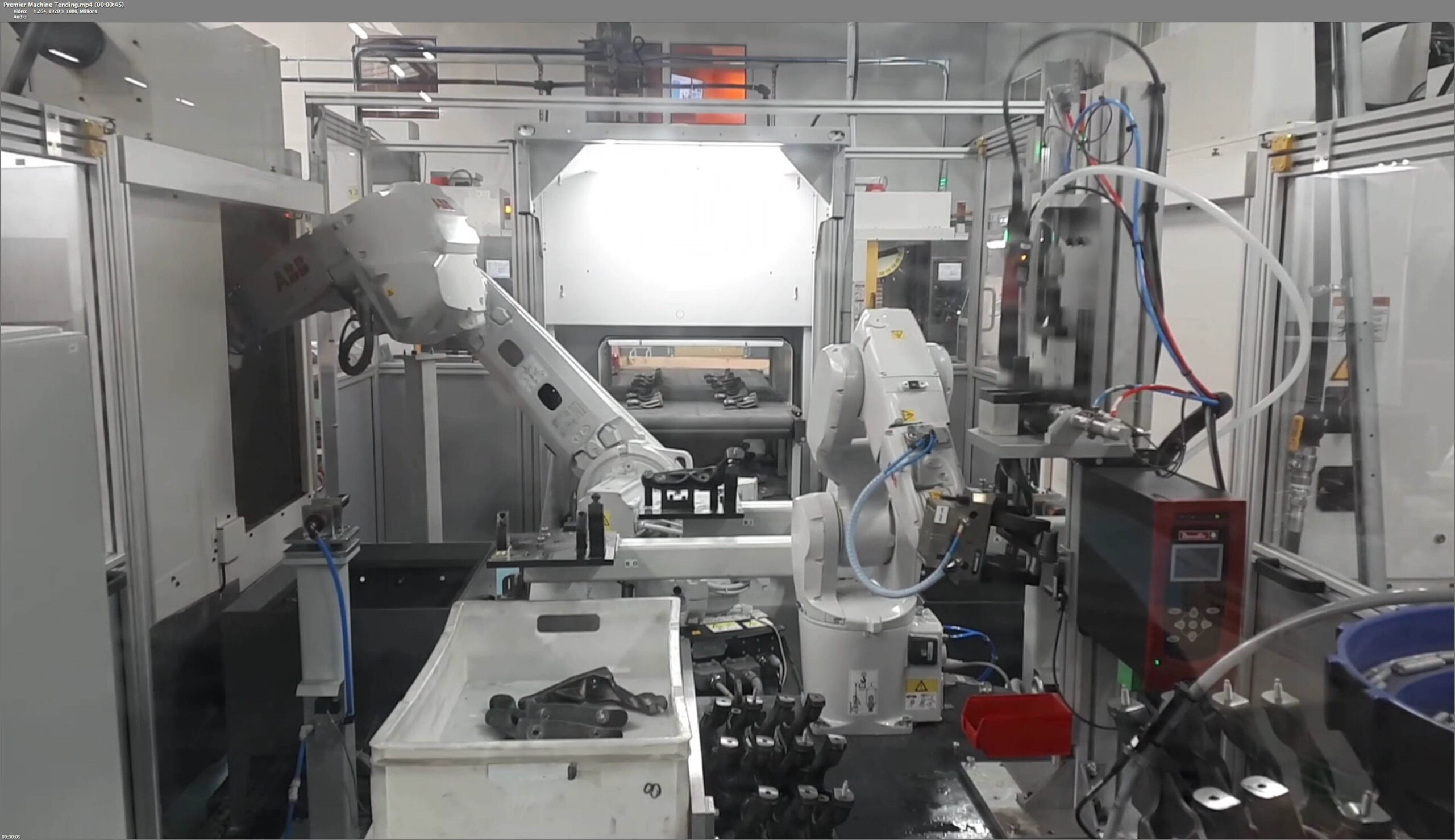
Robot integration can help manufacturers increase output by reducing delays, improving repeatability and allowing equipment to run for longer periods with less manual intervention. In applications such as machine tending, palletising, welding, gluing and gasket dispensing, a robot can carry out repetitive tasks consistently throughout a shift.
This can be especially valuable where production teams are dealing with labour shortages, physically demanding work or processes that rely heavily on operator consistency. A well-integrated robot cell can reduce cycle times, improve machine utilisation and help keep production moving during breaks, shift changes or quieter periods.
For some businesses, automation also creates the possibility of lights-out running. This may involve automatic machine loading, pallet conveyors, robot handling systems or AMR-supported workflows. The right approach depends on the product, process and available space, which is why integration needs careful planning rather than a one-size-fits-all design.
Why do I need Robot Integration? To improve quality and consistency
Manual processes can vary from person to person, especially when tasks are repetitive, tiring or require precise positioning. Robot integration helps deliver the same movement, force, path or placement again and again. This can reduce errors, improve product quality and limit waste caused by inconsistency.
In welding, for example, robotic systems can help produce repeatable weld paths and controlled movement. In gluing or gasket dispensing, robots can apply accurate beads around complex shapes. In palletising, robots can stack products neatly and consistently, helping to reduce damage during storage and transport.
Premier Automation has experience integrating a wide range of robot models from leading manufacturers across multiple applications. The company also holds ABB Value Provider status, recognising its integration, programming and training capability. For customers, this matters because a robot system is only as strong as the way it is designed, programmed, guarded, commissioned and supported.
Reducing risk with the right safety and control systems
Safety should be built into any automation project from the start. Robot cells may require guarding, safety-rated controls, access management, risk assessment and operator training. Collaborative robots can offer a more flexible option for some tasks, but they still need proper assessment to make sure the full application is safe.
The Health and Safety Executive provides guidance on workplace equipment and machinery safety, including employer responsibilities around safe use, maintenance and training. Manufacturers considering automation should review relevant guidance from the HSE machinery safety pages and work with an integrator who understands practical safety requirements.
Control systems are also central to the success of any robot cell. A robot often needs to communicate with conveyors, sensors, machine tools, presses, vision systems, PLCs and wider factory systems. Premier Automation designs and builds control systems in-house, including schematics, panel layouts, cable schedules, safety reports and controls risk assessments. This helps ensure the system is not only functional, but also clear for operators and maintainable for the future.
Why do I need Robot Integration? To make better use of existing equipment
Not every automation project starts with a brand-new robot. Many manufacturers already have systems that could perform better with the right upgrade, re-engineering or relocation. Why do I need Robot Integration? In this situation, the answer may be to extend the life of existing investment rather than replace it.
An older robot cell may have become inefficient after years of use. The product may have changed, throughput requirements may have increased, or the system may need new tooling, programming or guarding. A site survey can identify which parts of the system are still suitable and which need updating.
Premier Automation can assess, modify, upgrade and relocate existing robot systems locally, nationally or internationally. Its team can also manufacture supporting items in-house, including robot pedestals, frames, guarding, tooling and spreader plates. This can be useful when changes are needed quickly to keep production moving.
Choosing the right automation partner
Good robot integration is about more than choosing a robot brand. It involves understanding the production problem, the product variation, the available space, operator needs, safety requirements, budget and expected payback. The British Automation & Robot Association offers useful industry insight into automation and robotics through BARA, showing how broad the sector has become across UK manufacturing.
Working with an experienced integrator helps avoid costly mistakes. A system that looks impressive but does not suit the real production environment can become difficult to operate, maintain or justify commercially. An honest assessment at the start can show whether automation is suitable, what type of system is best and how quickly value is likely to be achieved.
Based in Bedford, Premier Automation operates from a large facility with strong transport links to support manufacturers across the UK. Founded in 2000, the company has grown into one of the UK’s leading suppliers of robot-based automation and control systems, supporting projects from single robot cells to complex automated systems.
Frequently Asked Questions
What is robot integration?
Robot integration is the process of designing, installing and commissioning a robot system so it works correctly with the rest of your production equipment. This can include tooling, guarding, PLCs, conveyors, machine interfaces, sensors, software and operator controls.
Can a used robot be integrated into a new system?
Yes. A used robot can often be integrated into a new or modified system if it is suitable for the task, payload, reach, condition and safety requirements. Premier Automation can assess existing robots and advise whether re-use is practical and cost-effective.
Will robot integration reduce downtime?
It can, when the system is properly designed and supported. Offline programming, digital twin tools and careful commissioning can help reduce disruption during installation or modification. Upgrading older systems can also restore lost performance and improve reliability.
Is automation suitable for every manufacturing process?
No. Some processes are not suitable for automation, or may not offer a strong enough return on investment. A good integrator will provide honest advice and help identify whether a robot system, control upgrade, cobot cell or another solution is the best route.
If you are reviewing production efficiency, planning a new robot cell or looking to improve an existing automated system, Premier Automation can provide practical guidance, design expertise, control system support and full robot integration services tailored to your process and payback goals.