
What is a Collaborative Robot? A Practical Guide for Manufacturers
What is a Collaborative Robot? It is a robot designed to operate safely alongside people within a shared working environment. Often known as a cobot, it can support employees with repetitive, precise or physically demanding processes while allowing human skills and judgement to remain part of the operation.
What is a Collaborative Robot? How the Technology Works
Collaborative robots use safety functions such as force limitation, speed monitoring and controlled stopping. These features enable the robot to detect contact, resistance or movement within its working area and respond appropriately.
Cobots are generally compact and straightforward to programme. An operator can often guide the robot arm through the required movement, save positions and create a sequence through an accessible interface. This makes it easier to adjust the system when a product, component or production requirement changes.
The robot is only one part of the completed installation. Grippers, fixtures, sensors, controls and surrounding machinery must also be considered. A risk assessment is required for every application, even when the robot includes collaborative safety functions. The HSE guidance on machinery safety explains the responsibilities associated with workplace equipment.
What is a Collaborative Robot? Common Applications
Cobots can support a wide range of manufacturing, packaging and material-handling processes. Typical applications include machine loading, palletising, assembly, inspection, gluing, gasket dispensing and component transfer.
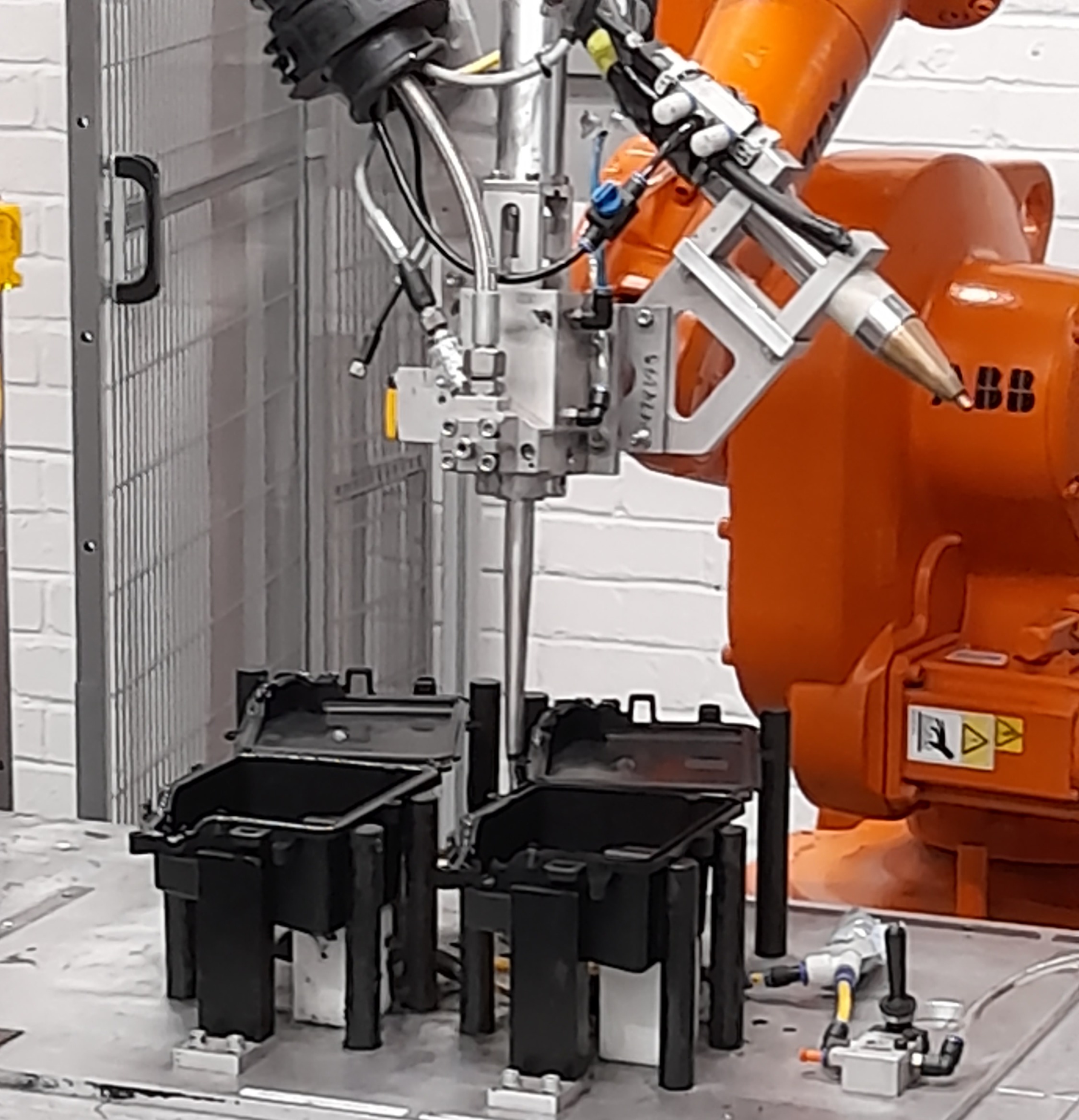
For machine loading, a cobot may collect an unfinished component, place it into a CNC machine and remove it once the machining cycle is complete. A palletising cobot can lift cartons from a conveyor and arrange them consistently on a pallet. Gluing systems can follow programmed paths accurately, helping to produce a controlled and repeatable bead.
These robots can be particularly useful for high-mix, lower-volume production. Programmes and tooling can be changed to accommodate different products, allowing manufacturers to automate processes that may not justify a permanently dedicated industrial robot cell.
Benefits of Cobots for Manufacturers
Flexibility is one of the main advantages of collaborative automation. The relatively small footprint of a cobot may allow it to be installed within an existing production area without extensive changes to the factory layout.
A correctly designed system can also improve consistency. The robot repeats the same programmed movement during every cycle, reducing variations caused by fatigue or manual handling. This can support more predictable output, fewer handling errors and better control over product quality.
Cobots may also reduce the physical demands placed on employees. Repetitive lifting, loading or positioning tasks can lead to strain, particularly where awkward components are handled throughout a shift. Transferring these processes to a robot allows employees to concentrate on inspection, problem-solving and other skilled responsibilities.
The commercial benefits depend on the complete process. Cycle time, part presentation, machine availability, tooling reliability and storage capacity all affect potential output. A realistic proposal should assess productivity, labour requirements, maintenance and expected payback rather than focusing only on the cost of the robot.
What is a Collaborative Robot? Comparing Cobots and Industrial Robots
Traditional industrial robots are commonly selected for high-speed, high-payload or large-reach applications. They usually operate inside guarded cells because their movement and force may create significant risks. These systems remain highly effective for welding, heavy palletising and demanding production processes.
Cobots are generally designed for closer interaction with employees. They may operate at lower speeds and handle lighter payloads, but they can be easier to programme, move and adapt. This does not make a cobot suitable for every application.
The correct choice depends on the required payload, reach, accuracy, cycle time and level of human interaction. A conventional robot may provide better productivity for a fast, repetitive process, while a cobot may be more suitable where flexibility and shared access are priorities. The British Automation & Robot Association provides further information about robotics and automation in the UK.
Understanding Collaborative Robot Safety
A cobot is not automatically safe simply because it has built-in safety features. The complete application must be assessed. The shape of the gripper, the component being carried, sharp edges, trapping points and nearby equipment can all introduce hazards.
Suitable safety measures may include reduced speeds, safe stopping distances, scanners, light guards, pressure-sensitive equipment or physical guarding around specific areas. Some systems only operate collaboratively during part of the production cycle. The robot might slow down when an employee enters the shared workspace and return to a higher speed when the area is clear.
Professional integration should balance safe operation with practical production performance. Controls risk assessments, system testing, technical documentation and operator training should form part of the completed project.
What is a Collaborative Robot? Choosing the Right System
The process should be assessed before a particular robot model is selected. Manufacturers need to consider component weight, required reach, accuracy, available floor space, production speed and how materials will enter and leave the system.
End-of-arm tooling is another important consideration. The gripper must hold the component securely without damaging it. It may also need to handle several part types or complete secondary operations. Machine interfaces, PLC communication and safety controls must work together reliably.
Premier Automation designs new robot systems, integrates used robots and modifies existing automated equipment. Its engineers can review the process, identify suitable technology and develop a solution that meets technical requirements and commercial payback criteria from its facility in Bedford.
Frequently Asked Questions
Can a cobot operate without safety fencing?
Sometimes, but this depends on the risk assessment. Tooling, payload, speed and surrounding machinery may mean that additional guarding or safety equipment is required.
Are cobots suitable for smaller manufacturers?
Yes. Their compact size and adaptable programming can make them suitable for small and medium-sized manufacturers, particularly where production includes several product variations.
Can one cobot perform several tasks?
Yes, provided each task has suitable programming, tooling and safety measures. Quick-change grippers and mobile bases can make redeployment more practical.
How is the payback period calculated?
Payback is based on system cost, operating hours, labour savings, productivity gains and quality improvements. A detailed review is needed to provide a realistic calculation.
Planning a Successful Collaborative Robot Project
A successful automation project starts with a clear understanding of the process and the result the manufacturer needs to achieve. Premier Automation can provide system assessment, design, manufacture, robot and PLC programming, installation, commissioning and after-sales support. The team can also upgrade or relocate existing systems where this provides a practical and cost-effective route to improved productivity.