
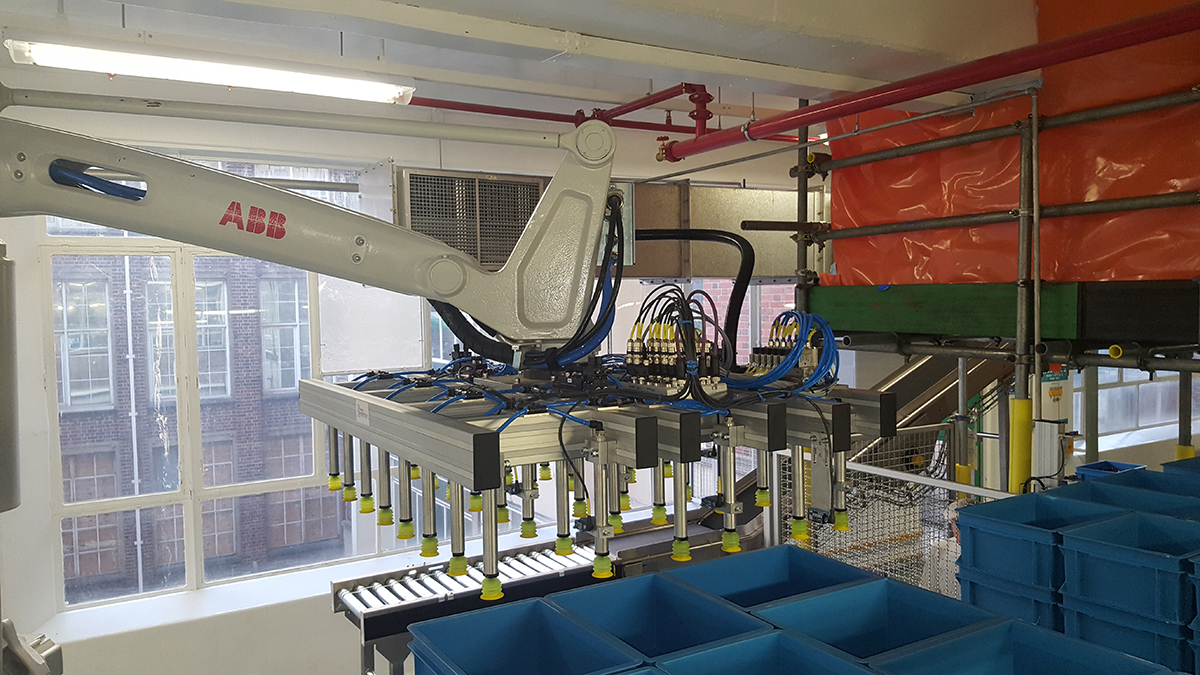
Industrial Robots vs Collaborative Robots is a practical choice that affects throughput, floor space, safety planning and long-term operating costs. The right option depends less on which technology is newer and more on the task, the product range and how people need to work around the cell. Premier Automation helps manufacturers assess these factors before designing a system that supports reliable production.
Industrial Robots vs Collaborative Robots: The Core Difference
Industrial robots are built for high-speed, repeatable work in dedicated automated cells. They commonly handle heavier payloads, longer reaches and demanding processes such as welding, palletising, machine tending and dispensing. A conventional robot normally operates behind physical guarding or with safety devices that prevent people entering its working area while the robot is moving.
Collaborative robots, often called cobots, are designed to operate nearer to people under carefully assessed conditions. They have safety-related functions such as force and power limiting, speed monitoring and controlled stopping. This does not mean a cobot is automatically safe to touch or that guarding is never needed. The gripper, tooling, sharp parts, load and surrounding machinery can all introduce hazards that must be addressed.
Industrial Robots vs Collaborative Robots: Speed, Payload and Flexibility
For consistently high volumes, an industrial robot is usually the stronger choice. Its speed, payload capacity and ability to run continuously can make it effective for lifting cases, tending several machines or completing fast cycle-time tasks. A robust cell can also accommodate purpose-designed fixtures, conveyors and end effectors that increase consistency and reduce manual handling.
Cobots often suit lower-volume work, frequent product changes and applications where an operator needs to load parts, inspect output or perform a complementary task. Their compact footprint can be valuable where space is limited. Programming and redeployment may be simpler, but the full installation still needs engineering. A slow cobot may not achieve the output of a conventional robot, particularly if it pauses regularly for human interaction.
Industrial Robots vs Collaborative Robots: Safety and Compliance
Every robot installation needs a documented risk assessment. In the UK, the HSE machinery safety guidance covers employer duties under the Provision and Use of Work Equipment Regulations 1998 (PUWER), including ensuring work equipment is suitable, maintained and used safely. Safety design should consider foreseeable actions, including clearing jams, changing tools, restarting after a stop and maintenance access, rather than only normal production.
ISO 10218 is the principal international safety standard series for industrial robots and robot systems. ISO/TS 15066 provides additional guidance for collaborative applications, including the collaborative operating modes and considerations around contact. A proper assessment examines the complete system, not merely the robot arm. For example, a rounded cobot arm can still present a trapping point if it moves towards a fixed jig, or a hazardous risk if it carries a sharp blade.
How to Select the Best Automation Approach
Start with measurable requirements: target output per hour, payload including the end effector, reach, accuracy, changeover frequency, available floor area and planned shifts. Also consider variation in incoming parts. A robot can only deliver dependable performance if parts are consistently presented, whether through a fixture, conveyor, vision system or operator loading position. Industrial Robots vs Collaborative Robots becomes clearer once these production realities are mapped.
Total cost should include more than the arm itself. Budget for grippers, safeguarding, fixtures, controls, integration, installation, operator training and support. A used or re-engineered industrial robot can be an economical route for suitable applications, while a cobot may reduce the footprint and simplify deployment for a modest task. The best value comes from a system sized for the required output, not from selecting the lowest initial price.
Frequently Asked Questions
Can a cobot work without safety guarding?
Sometimes, but not by default. The application risk assessment determines whether additional guarding, scanners, safety-rated speed reduction or other protective measures are needed. Tooling, payload and pinch points are often decisive.
Are industrial robots only suitable for large factories?
No. Smaller manufacturers can benefit from industrial robots for repeatable, labour-intensive work. A compact cell for machine tending or palletising can deliver consistent output without requiring a large site.
Which option is better for palletising?
It depends on box weight, stack pattern, line speed and shift pattern. Industrial robots generally suit heavier loads and higher rates, while cobots can be effective for lighter, lower-speed palletising tasks where space is constrained.
Is Industrial Robots vs Collaborative Robots mainly a choice about safety?
Safety is essential for both, but it is only one factor. Required cycle time, payload, reach, product variation, staffing and future expansion all influence which system will provide the most useful return.
For a clear assessment of your process, Premier Automation can design, build, install and support robot and control systems, from collaborative applications to high-performance industrial cells. A well-scoped review can identify a practical route to safer, more consistent production.