
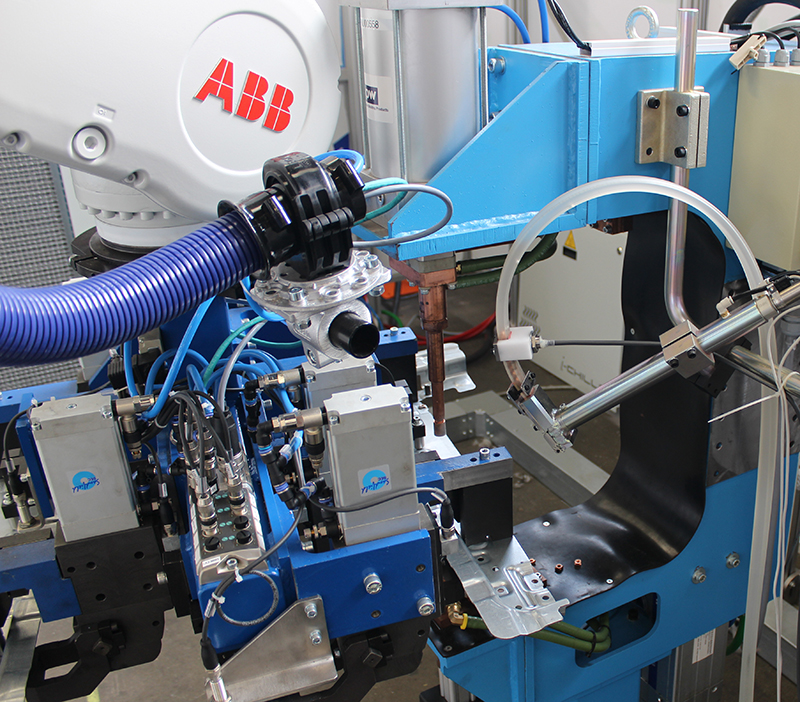
What is Industrial Robot Automation? It is the use of programmable robotic equipment to complete repeatable production tasks with reliable speed, precision and control. Rather than replacing an entire factory at once, a robot cell is usually designed around one clearly defined job, such as loading a machine, stacking finished goods or applying adhesive. For manufacturers, the aim is practical: improve consistency, protect people from unsuitable manual work and create capacity without compromising quality.
What is Industrial Robot Automation? How a Robot Cell Works
An industrial robot is a mechanical arm, gantry or mobile unit that follows programmed instructions. It works with tooling chosen for the task, such as a gripper, welding torch, vacuum cup or dispensing nozzle. Sensors, safety equipment, conveyors and a control system complete the cell. A programmable logic controller, often called a PLC, coordinates the robot with surrounding machinery so that materials arrive, the task is performed and the finished part moves safely to the next stage.
Robots can be configured for simple, repetitive movements or for more demanding applications involving cameras, measurement systems and multiple product variants. Machine tending is a common example: the robot loads raw parts into a CNC machine, removes completed components and presents them for inspection or packing. This can maintain a steady workflow while allowing operators to focus on set-up, checks and exception handling.
Where What is Industrial Robot Automation? Adds Value
The strongest cases are often tasks that are repetitive, physically demanding, hazardous or difficult to staff consistently. Palletising, welding, gluing, gasket dispensing, packing and loading equipment are established uses. A correctly specified system can also reduce variation caused by fatigue, improve traceability and make cycle times more predictable. Automation is not automatically the right answer for every operation, but it can make a measurable difference where bottlenecks repeatedly restrict output.
-
Machine tending can extend unattended running between planned checks and reduce repetitive loading.
-
Palletising can produce stable, repeatable stacks while reducing lifting and twisting for employees.
-
Dispensing systems can control the position and volume of adhesives or sealants more consistently than manual application.
Collaborative robots, or cobots, are another option for suitable lower-force tasks. Their safety features may allow closer working alongside people, but they are not automatically safe in every setting. The tool, workpiece, speed, reach, pinch points and the whole process must be assessed. A cobot handling a sharp component or operating beside a conveyor may still need guarding or other protective measures.
Safety, Risk Assessment and What is Industrial Robot Automation?
Safety should shape the project from the first layout discussion, not be added after a robot has been selected. The system needs safeguards appropriate to the hazards, which may include fixed guards, interlocked doors, light curtains, safety scanners and emergency-stop devices. The risk assessment must consider foreseeable actions such as clearing a jam, changing a fixture, teaching the robot and restarting after a stop.
The HSE’s machinery safety guidance on the Provision and Use of Work Equipment Regulations 1998 (PUWER) explains that work equipment must be suitable, maintained and used by people with adequate information, instruction and training. In practice, this means a safe cell depends on documented operating procedures and trained users as well as physical guarding. Validation at commissioning should test safety functions and normal production sequences before handover.
Planning a Successful Robot Project
Start with accurate information about the current process: part sizes and weights, production volumes, changeover frequency, available floor space, cycle time and quality requirements. Do not overlook variability. A robot can handle a broad family of parts, but fixtures, grippers and programming must accommodate the real differences rather than the ideal drawing. Recording stoppages and manual interventions over several weeks often reveals where automation will deliver the most worthwhile return.
Integration is equally important. A robot must communicate reliably with machines, conveyors and safety controls, while the layout must leave space for loading, maintenance and material flow. Early simulation and proof-of-concept testing can identify reach limitations, collisions and awkward operator access before installation. Planning for support, spare parts and future product changes also helps protect the investment over its working life.
A specialist partner can design the cell around your production needs, build the controls, programme the robot and commission the complete installation. At its facility in Bedford, Premier Automation delivers new and re-engineered robot systems, control solutions, upgrades and after-sales support for manufacturers with both straightforward and complex requirements.
Frequently Asked Questions
What is Industrial Robot Automation? Can it suit low-volume production?
Yes, provided the expected part changes and set-up needs are built into the design. Flexible tooling, stored programmes and quick-change fixtures can make automation viable for lower volumes, particularly where the same handling or finishing task is repeated across several product types.
What is Industrial Robot Automation? Does it mean fewer jobs?
Not necessarily. Many businesses use robots to take on repetitive, heavy or undesirable tasks where recruitment is difficult. Employees can move into roles involving quality checks, machine set-up, maintenance, material control and production supervision, supported by appropriate training.
How long does installation take?
Timescales depend on the application, equipment interfaces, safety requirements and testing needed. A well-defined standalone cell is usually quicker than a multi-machine line. Clear specifications, sample parts and prompt decisions during design help keep a project on schedule.
If you are assessing a new cell, an upgrade or a used-robot integration, Premier Automation can help you review the task, define a practical solution and support it from design through commissioning.