How flexible are Industrial Robot Systems? For many businesses, the answer is far more flexible than a single-purpose production line, provided the cell is specified properly. A robot can be programmed to perform repeatable tasks accurately, then adapted for new products, different pack formats or revised process requirements. The practical limits depend on tooling, safety design, available space, product variation and the way the system is controlled.
How flexible are Industrial Robot Systems? In day-to-day production
Industrial robots are naturally suited to repeatable work such as machine tending, palletising, welding, dispensing and assembly. Their flexibility comes from software: a programmed robot can follow alternative paths, select different positions and react to signals from sensors or connected machinery. This allows one cell to handle a planned range of products without rebuilding the whole process.
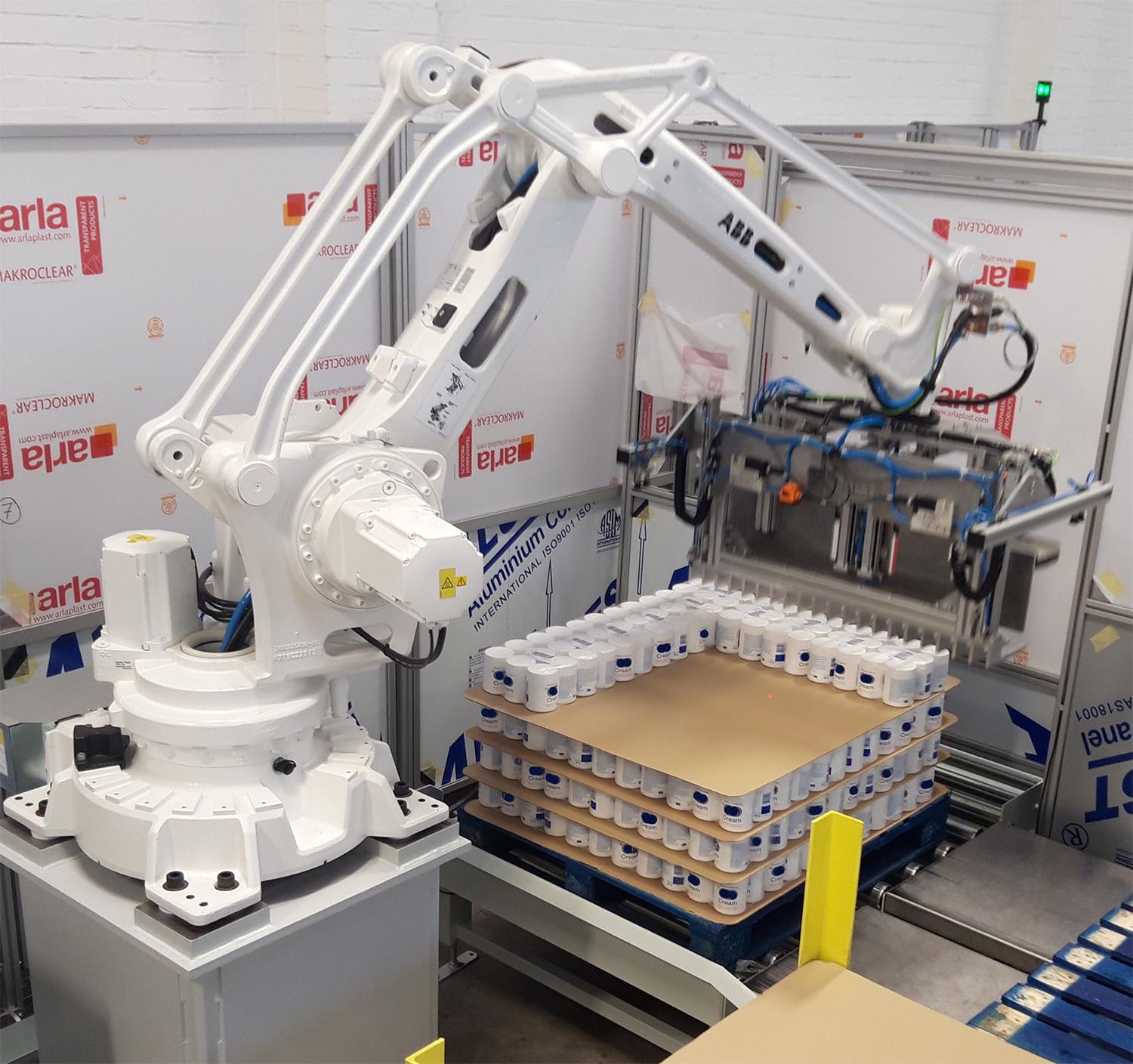
Changeovers can be quick where products share similar dimensions, weights and handling needs. For example, a palletising system may run several case sizes by selecting a stored recipe, while a machine-tending robot can use different gripping positions for a family of components. The robot itself is only one part of the solution; fixtures, conveyors, vision equipment and end-of-arm tooling must also support the change.
-
Recipe-driven programs support approved product variants and repeatable set-up.
-
Quick-change grippers reduce manual intervention between compatible jobs.
-
Vision systems can identify position, orientation or selected product features.
What determines the useful flexibility of a robot cell?
Payload and reach set the physical boundaries. A robot that can lift the heaviest item may still be unsuitable if its wrist cannot reach every required location, or if acceleration makes a fragile product unstable. Cycle time matters too: a flexible system should retain enough capacity for peak demand rather than becoming a bottleneck after a product change.
How flexible are Industrial Robot Systems? The most useful answer starts with the full production task, not the robot model. Consider product sizes, tolerances, surface finishes, batch quantities, incoming orientation and future packaging plans. A modular cell with spare I/O, accessible cable routes and room for an extra station is usually easier to extend than a tightly packed installation designed only for one current product.
How flexible are Industrial Robot Systems? Tooling makes the difference
End-of-arm tooling is often the deciding factor. A vacuum gripper may handle many cartons but not porous, uneven or dusty materials reliably. Mechanical fingers may offer a stronger hold, yet need adjustment for size changes. Multi-tool changers, adjustable grippers and servo-controlled axes can broaden the range of products a robot handles, but should be justified by realistic production needs.
Control design also affects adaptability. Clear operator screens, named recipes and sensible permissions make routine changes easier without exposing critical robot settings. Integration with PLCs, barcode readers and vision systems can automate product selection, reducing the chance of an operator loading the wrong programme. Good documentation is equally valuable for training, troubleshooting and future modifications.
How flexible are Industrial Robot Systems? Safety and compliance still apply
Flexibility must never bypass safeguarding. Each new product, tool or operating mode can alter pinch points, speed, reach and the risk of dropped loads. The HSE machinery safety guidance explains the duties under the Provision and Use of Work Equipment Regulations 1998 (PUWER), including the need for work equipment to be suitable, maintained and used by appropriately trained people. A risk assessment should be reviewed whenever the cell changes.
Collaborative robots can provide useful flexibility where people need to work near automation, but they are not automatically safe without guards. Tool shape, payload, movement speed, workspace and the wider process all influence the protective measures required. In some applications, conventional industrial robots behind perimeter guarding remain the safer and more productive choice.
Planning for expansion without over-specifying
A sensible project balances present needs with likely change. Start by defining which products genuinely need to run on the cell, their volumes and the expected changeover frequency. Then identify additions that are economical now, such as a larger robot reach, a flexible gripper interface or panel capacity for future equipment. Avoid paying for every theoretical possibility if it will never be used.
Before commissioning, ask to see representative products processed at the intended speed and with the planned handling method. Acceptance testing should cover changes between recipes, recovery after a stoppage and safe access for cleaning and maintenance. These details reveal whether a proposed system is flexible in a useful operational sense, rather than merely capable on paper.
Frequently Asked Questions
Can one robot carry out several different tasks?
Yes, if its reach, payload, tooling and cycle time suit each task. It may use multiple tools or stations, although combining unrelated jobs can make programming and scheduling more complex.
How flexible are Industrial Robot Systems?
They can be highly adaptable for planned product ranges and repeatable variations. Major changes in material, weight, process or required throughput may need new tooling, programming, guarding or additional equipment.
Are used robots suitable for flexible automation?
They can be, provided their condition, controls, safety provisions and availability of support are assessed carefully. Re-engineering can make a proven robot a cost-effective part of a modern cell.
A practical next step for your automation project
A site review can turn broad flexibility requirements into a workable specification for your products and production targets. Premier Automation can design, build, integrate, upgrade and support robot systems that provide practical scope for change while maintaining reliable, safe operation.