Businesses seeking Factory Automation Solutions in London often need more than a single robot or conveyor. They need a system that removes a genuine production constraint, fits safely into the available space and continues to perform as demand changes. A well-planned automation project can improve consistency, protect staff from repetitive or hazardous tasks and give managers clearer control over output. The best starting point is a practical review of the process, the product range and the results the business wants to achieve.
Benefits of Factory Automation Solutions in London
Automation can bring measurable improvements to operations with frequent handling, assembly, packing or finishing tasks. Robots can repeat programmed movements accurately over long shifts, helping to reduce variation caused by manual handling. This is particularly useful where product quality depends on reliable positioning, dispensing, welding or inspection. It can also help businesses increase capacity without relying solely on recruitment in a competitive local labour market.
The value is not limited to speed. A carefully designed cell can improve traceability, reduce material waste and create safer separation between people and high-risk equipment. For example, a palletising system can build stable loads to a defined pattern while giving operators a more manageable role in supplying materials, checking finished pallets and resolving exceptions. The aim should be a better process, rather than simply replacing one activity with a machine.
Choosing Factory Automation Solutions in London for Your Process
Start by identifying the task that causes the greatest delay, quality issue or safety concern. Record cycle times, changeover requirements, product dimensions and the number of variations that the system must handle. This information helps determine whether the right approach is a conventional industrial robot, a collaborative robot, purpose-built machinery or an upgrade to an existing control system. It also prevents a solution being sized around an assumed output instead of real production data.
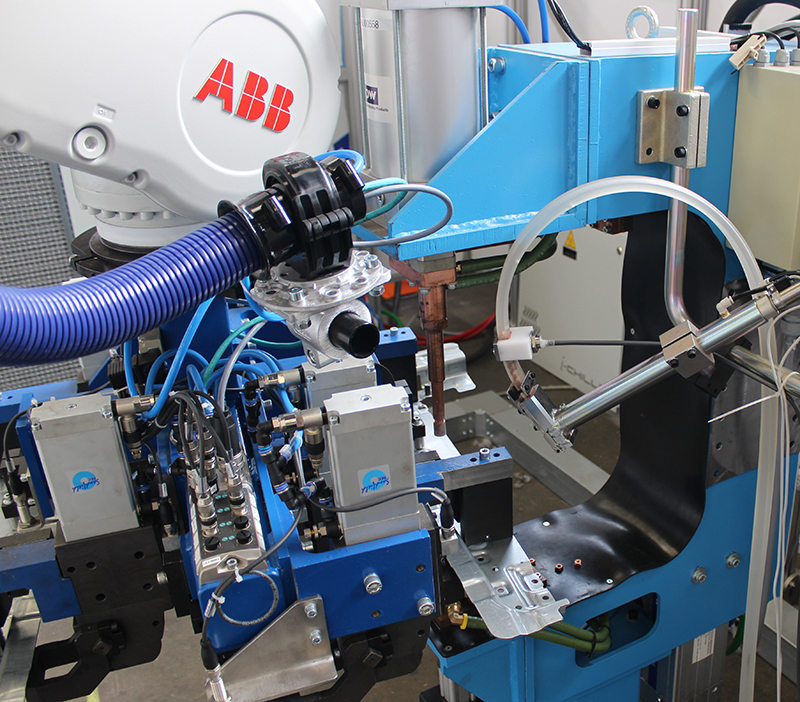
Machine tending, palletising, welding and gluing or gasket dispensing are common applications, but each needs a different approach to tooling and controls. A component that arrives in several orientations may require a vision system or a fixture. Products with frequent format changes may benefit from quick-change grippers and stored recipes. Considering these details early avoids costly redesigns after installation.
Designing Factory Automation Solutions in London Around Real Production
A useful proposal should explain how parts enter and leave the cell, where operators work, how faults are handled and how production is maintained during maintenance. Floor space is only one consideration. Access for material deliveries, fork-lift routes, guarding, electrical supplies and future expansion can all affect the final layout. For sites with limited room, a compact robot cell or cobot may provide a sensible route to automation without a major building alteration.
Controls are equally important. Clear human-machine interface screens, alarm messages that point to a likely cause and sensible manual recovery procedures help operators use the system confidently. Integration with upstream and downstream equipment should be planned from the outset, including signals for line status, product tracking and safe stopping. This creates a connected process rather than a standalone machine that introduces a new bottleneck.
Safe Factory Automation Solutions in London
Safety must be built into the design, not added once equipment is ready to run. Risk assessment should consider foreseeable use, cleaning, setting, fault recovery and maintenance, as well as normal automatic operation. The HSE guidance on the Provision and Use of Work Equipment Regulations 1998 (PUWER) makes clear that work equipment must be suitable, maintained and used by people with adequate information, instruction and training. Guarding, interlocks, emergency stops and safe access arrangements must suit the specific installation.
Collaborative robots can work alongside people in appropriate applications, but they are not automatically safe without assessment. Tooling, payloads, pinch points, speed, reach and the surrounding process all matter. A collaborative installation may still need protective measures or restricted operating modes. Staff training should cover everyday operation, safe restart procedures and the limits of what an operator should attempt before calling for support.
Planning Factory Automation Solutions in London from Installation to Support
A staged delivery plan reduces disruption. It should cover design approval, build, factory testing, site preparation, installation, commissioning and operator handover. Where possible, testing the control sequence before arrival on site identifies issues before they affect production. Businesses should also agree realistic acceptance criteria, such as output rate, quality checks, cycle time and the products to be run during commissioning.
Long-term support deserves the same attention as the initial build. Keep current drawings, robot and PLC program backups, spare-part recommendations and a maintenance schedule. Existing robot systems can often be re-engineered, relocated or upgraded instead of replaced, particularly where the mechanical structure remains sound but controls, guarding or tooling no longer meet operational needs. This can provide a practical route to improved capability while protecting earlier investment.
Frequently Asked Questions
How long does an automation project take?
Timescales depend on the complexity of the task, equipment lead times and site readiness. A defined single-cell project can move faster than a multi-machine line, but allowing time for testing, training and commissioning helps deliver a more reliable result.
Can an existing robot be upgraded?
Often, yes. Controls, safety systems, end-of-arm tooling and programming can be updated to suit new products or improve performance. A site assessment will establish whether refurbishment offers sufficient value compared with a new system.
Will automation remove the need for operators?
Automation usually changes roles rather than removing them entirely. People remain essential for quality checks, material supply, changeovers, supervision and dealing with exceptions. The right design makes these responsibilities clearer and less physically demanding.
For a practical assessment of your process, Premier Automation can design, build, install and support robot-based systems and tailored controls. Their team can help you identify a sensible starting point, whether you are automating a single task, upgrading a cell or planning a wider production improvement.