How can Robot Integration help with Manufacturing? A Practical Guide for UK Producers
How can Robot Integration help with Manufacturing? For many production businesses, the answer is found in better output, safer processes, more consistent quality and a stronger return on investment. Robot integration is not simply about buying a robot and placing it on a factory floor. It is about designing a complete automated system around your process, products, space, workforce, safety requirements and commercial goals.
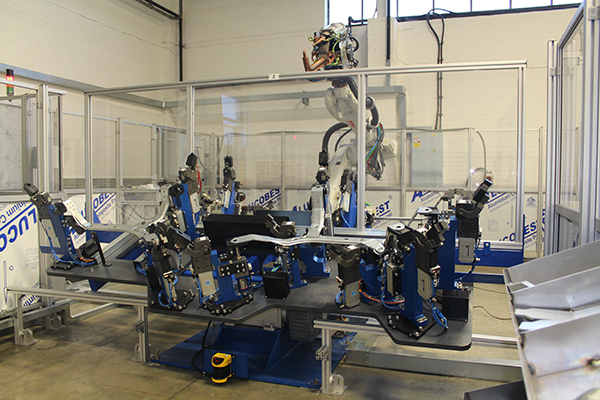
Premier Automation designs and builds new robot systems, integrates used robots, and modifies existing automated systems to suit individual production needs. Based in Bedford, the company supports manufacturers with cost-effective automation solutions across robot integration, control systems, upgrades, relocation, programming, machine tending, palletising, welding, gluing, dispensing and after sales support.
How can Robot Integration help with Manufacturing? By improving productivity
One of the clearest benefits of robot integration is increased productivity. Robots can carry out repetitive tasks with speed, accuracy and consistency, helping manufacturers reduce cycle times and keep production moving. For tasks such as machine tending, palletising, welding, dispensing or part handling, a well-designed robot cell can remove delays caused by manual loading, fatigue or inconsistent working speeds.
This does not always mean replacing people. In many cases, automation allows skilled operators to focus on higher-value work while robots handle the repetitive, heavy or awkward tasks. For example, a robot can load and unload CNC machines, presses or other production equipment, allowing machinery to run for longer periods with less direct supervision. In suitable applications, this can support lights-out production and help businesses make better use of existing machines.
How can Robot Integration help with Manufacturing? By improving quality and consistency
Manual processes can vary from operator to operator, especially where tasks are repetitive, precise or physically demanding. Robot integration helps reduce variation by applying the same movement, pressure, position and timing every cycle. This can be valuable in applications such as welding, gluing, gasket dispensing, part loading and palletising, where accuracy has a direct impact on product quality.
Consistent handling also reduces the risk of product damage. In palletising, for example, robots can stack products accurately and repeatedly, helping to create stable pallet loads for storage and transport. In machine tending, accurate part placement can reduce errors, improve repeatability and protect both the machine and the component being processed.
Premier Automation has experience integrating a wide range of robot models from leading manufacturers across many applications. This practical experience is important because every production environment is different. A successful system needs to be built around the real process, not forced into a generic automation package.
Planning safe and compliant automation systems
Safety should be considered from the start of any automation project. Robot cells, control systems, guarding, access points, emergency stops and operator interfaces all need careful planning. The HSE machinery safety guidance provides useful information for businesses using work equipment and machinery, and it highlights the importance of controlling risk in the workplace.
A properly integrated robot system should be designed with the correct safety measures for the application. This may include machine guarding, safety-rated control systems, interlocks, risk assessments and clear operator controls. Collaborative robots, or cobots, can be suitable for some applications, but they still need proper assessment and integration. Their built-in safety features do not remove the need for good system design.
Premier Automation delivers control system design, panel build, installation, commissioning and safety documentation as part of its wider automation capability. The control system is the heart of an automated process, so it must be functional, reliable and straightforward for operators to use.
How can Robot Integration help with Manufacturing? By supporting future flexibility
Manufacturing needs change over time. Products may be redesigned, production volumes may increase, or a factory layout may need to be reorganised. A key advantage of good robot integration is that systems can often be modified, re-engineered or relocated rather than completely replaced.
Existing robot systems can sometimes be upgraded to reduce cycle times, handle new products or improve efficiency. Used robots can also be integrated into new systems where this makes technical and commercial sense. This can help manufacturers control project costs while still gaining the benefits of automation.
How can Robot Integration help with Manufacturing? It can give businesses a practical route to improve output without always starting again from scratch. Premier Automation can assess existing systems, recommend improvements, relocate automation locally, nationally or internationally, and re-engineer robot cells to meet new requirements.
Offline programming can also support flexibility. By creating and testing programmes away from the live production cell, downtime can be reduced during installation or modification. Digital twin tools can help optimise cell design and programming before the system is physically changed, making projects smoother and less disruptive.
Choosing the right automation partner
Robot integration is most successful when the project starts with a clear understanding of the production challenge. Automation is not suitable for every process, and the best solution is not always the most complex one. A good integration partner should be able to assess the process honestly, explain the options clearly and design a system that meets both technical and payback criteria.
Industry bodies such as the British Automation & Robot Association provide useful insight into automation and robotics in the UK. For manufacturers considering investment, it is worth looking beyond the robot itself and focusing on the complete system: tooling, guarding, controls, programming, operator access, maintenance and future adaptability.
Premier Automation brings together designers, mechanical engineers, electrical engineers, programmers and control system specialists to manage projects of different sizes. From single robot cells to more complex automation systems, the aim is to provide robust, reliable solutions that match the customer’s process and commercial requirements.
For manufacturers reviewing productivity, quality, labour challenges or production bottlenecks, robot integration can provide a practical and measurable way forward. Premier Automation offers honest advice, system design, robot integration, control systems, upgrades, relocation, programming and ongoing support for businesses looking to improve manufacturing performance.
Frequently Asked Questions
Is robot integration suitable for every manufacturer?
No. Some processes are better suited to automation than others. The best starting point is a site assessment to review the process, product variation, cycle times, space, safety requirements and likely payback.
Can an existing robot system be upgraded?
Yes, many existing systems can be modified, re-engineered or reprogrammed to improve performance, reduce cycle times or handle new products. This can be more cost-effective than installing a completely new system.
What types of tasks can robots handle in manufacturing?
Common applications include machine tending, palletising, welding, gluing, gasket dispensing, material handling, loading, unloading and repetitive assembly tasks. The right choice depends on the process and production goals.
Can robot systems be relocated?
Yes. Robot systems can often be moved within an existing facility, transferred to a new UK site or relocated internationally. Careful planning helps reduce disruption and keeps the process as risk-free as possible.