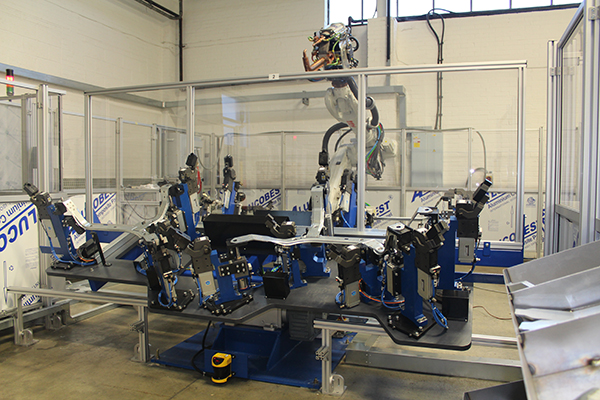
For manufacturers asking How do Industrial Robots improve Production Quality?, the practical answer is consistency. Robots repeat a programmed movement, force, speed and position without the fatigue, distraction or natural variation that can affect manual work. Used well, they help businesses make every part, pack or assembly closer to the approved standard, while giving people more time for skilled supervision, improvement and problem-solving.
Quality gains do not come from simply placing a robot beside a production line. The process, tooling, part presentation and controls must all be designed around the result required. A carefully integrated system can improve accuracy in welding, dispensing, machine tending, palletising and assembly, and can identify problems earlier rather than allowing defects to travel through the factory.
How do Industrial Robots improve Production Quality? By Repeating Proven Tasks
Once a process has been tested and approved, a robot can carry out the same sequence across every cycle. This is particularly valuable where a small variation has a large effect, such as the bead width of an adhesive, the angle of a weld torch, the tightening sequence of components or the placement of products in packaging. Repeatability reduces the spread between good outputs, making standards easier to maintain.
-
Consistent robot paths help control positioning and application patterns.
-
Defined cycle parameters reduce reliance on individual operator technique.
-
Automatic routines can run at a stable pace for long production batches.
Reliable fixturing is equally important. If a component is not presented in the same place each time, even a highly accurate robot cannot produce a dependable result. Sensors, vision systems, datum points and correctly designed grippers can confirm orientation and presence before the robot starts work. This prevents misaligned operations and reduces avoidable scrap.
How do Industrial Robots improve Production Quality? By Controlling Variation
Automation turns many quality-critical settings into controlled, reviewable data. Programmed speeds, temperatures, dwell times, forces and dispense volumes can be kept within agreed limits. Where a reading falls outside tolerance, the system can stop, reject the part or alert an operator. This is more effective than discovering a recurring fault only during an end-of-line inspection.
How do Industrial Robots improve Production Quality? They also make root-cause investigations more practical. Production teams can compare the robot programme, alarm history, sensor signals and batch information against the point at which a defect appeared. A gradual shift in a tool centre point, for example, may reveal wear in a fixture or gripper before it causes a significant quality issue. Scheduled calibration and maintenance protect the accuracy achieved at commissioning.
How do Industrial Robots improve Production Quality? Through Inspection and Traceability
Robots can work with cameras, barcode readers, load cells and other inspection devices to check work as it happens. A vision system may verify that a label is present and readable, while a force check can confirm that a component has seated correctly. Rather than relying solely on a final sample check, manufacturers can build verification into the process at the point where it matters.
Traceability is another useful advantage. Linking a part identifier to process settings, inspection results and fault records creates a clear production history. If a customer query arises, teams can review the evidence for the relevant batch instead of relying on paper records or assumptions. The answer to How do Industrial Robots improve Production Quality? therefore includes better evidence that each item was produced and checked as intended.
Designing a Safe, Maintainable Quality System
A quality-focused installation must be safe and straightforward to support. In the UK, the Provision and Use of Work Equipment Regulations 1998 (PUWER) require work equipment to be suitable, maintained and used by adequately trained people. Risk assessment, guarding, interlocks and safe access arrangements should be considered alongside throughput and quality targets, not added as an afterthought.
It also pays to involve operators early. Clear work instructions, sensible fault recovery screens and training help staff recognise when a process is outside its normal condition. Collaborative robots can be appropriate for certain shared tasks, but they still need a task-specific risk assessment and well-defined operating limits. The best systems make quality checks visible and give people a safe, simple way to respond.
Frequently Asked Questions
Can robots improve quality for small production runs?
Yes. Flexible tooling, offline programming and reusable robot cells can make automation viable for changing product ranges. The strongest case is usually a repetitive, quality-sensitive operation that is difficult to perform consistently by hand.
Will a robot remove the need for inspection?
No. Robots can automate checks and reduce variation, but inspection plans remain necessary. The right approach combines in-process verification, sensible sampling and review of quality data.
What information is needed before automating a process?
Useful starting points include current defect rates, cycle times, product tolerances, batch sizes, available floor space and the causes of rework. This information helps define realistic quality and return-on-investment goals.
Premier Automation can assess your existing process and develop robot-based automation, control systems and upgrades that support more consistent output. From design and build through to installation, commissioning and after-sales support, Premier Automation can help you create a practical route to stronger production quality.