How does Automated Palletising affect Employee wellbeing? A Practical Guide for Manufacturers
How does Automated Palletising affect Employee wellbeing? For many manufacturers, the answer is closely linked to safer handling, reduced physical strain and a more stable working environment. Palletising is often one of the most repetitive and demanding tasks on a production line, especially where boxes, bags, cases or trays are lifted for long periods. By using robotic or cobot palletising systems, businesses can reduce manual handling pressures while supporting better productivity and consistency.
Premier Automation designs and builds robotic automation systems for manufacturers that need practical, cost-effective solutions. From new robot systems to upgrades, relocations and re-engineered cells, the aim is to match automation to the customer’s process, payback criteria and production demands.
How does Automated Palletising affect Employee wellbeing? Reducing manual handling strain
Manual palletising can place significant stress on the body. Operators may need to lift, twist, bend and reach repeatedly throughout a shift. Even when individual products are not especially heavy, the cumulative effect can lead to fatigue, discomfort and a higher risk of musculoskeletal problems.
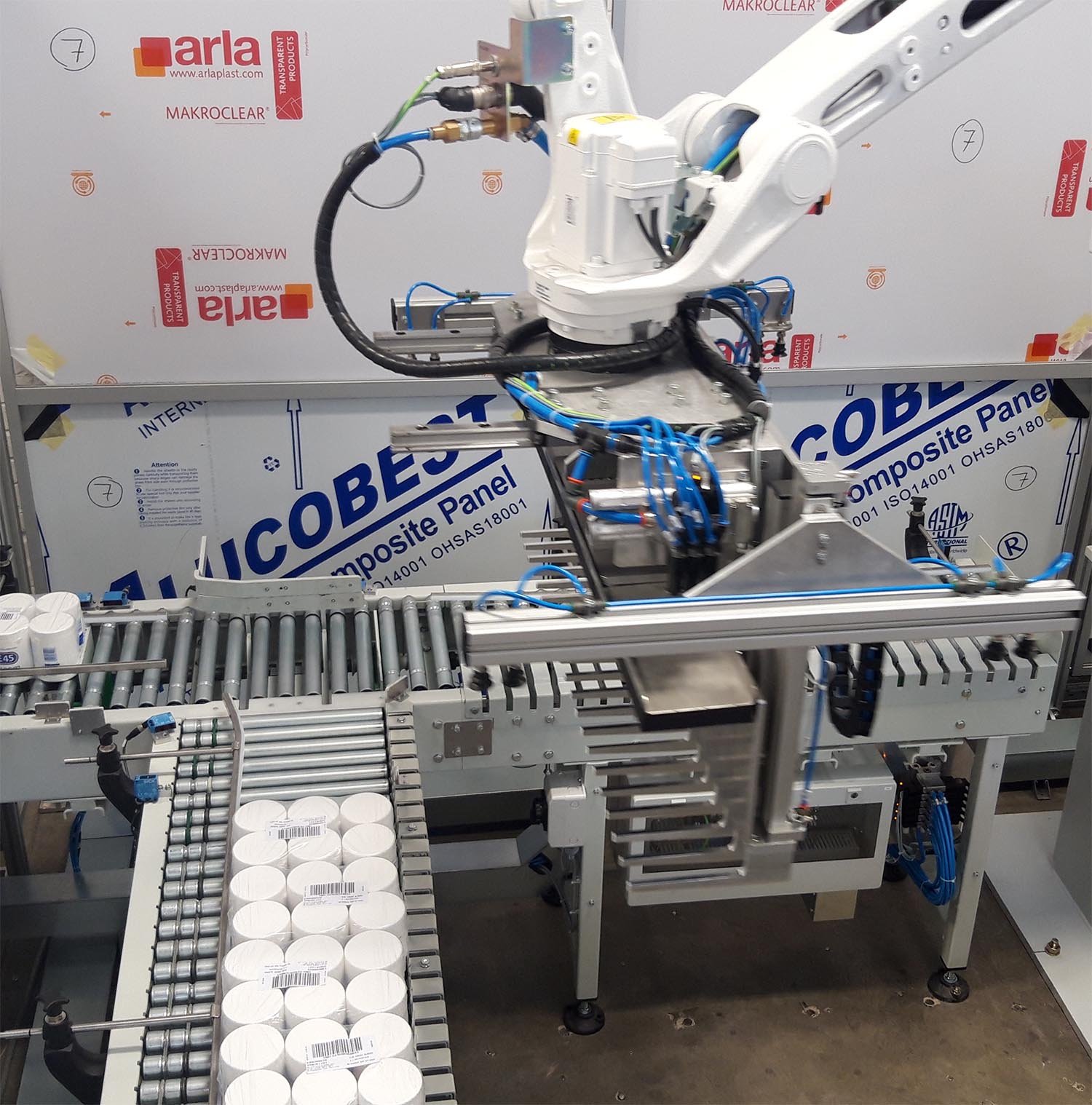
Automated palletising helps by moving the repetitive lifting element away from employees. A robot or cobot can pick products from a conveyor and stack them in a defined pallet pattern with consistent speed and accuracy. This is particularly useful for production environments where output volumes are high, shift patterns are long, or product formats change regularly.
The Health and Safety Executive provides guidance on workplace machinery and equipment safety, including the need to manage risks properly when using automated systems. You can find more information through the HSE machinery and work equipment guidance.
Improving safety without losing operational control
Good automation should make a workplace safer without making it harder to run. In palletising applications, this often means designing the right cell layout, guarding, infeed conveyors, pallet positions, controls and operator interface. The system needs to fit the site, the product and the way the team works.
Premier Automation has experience designing palletising systems for single and multiple lines, including robotic cells based around ABB palletising robots and cobot systems using ABB GoFa. These systems can be integrated with supporting equipment such as stretch wrappers, pallet conveyors and product orientation systems, depending on the application.
Safety is not only about reducing lifting. It also includes predictable machine movement, clear access points, safe maintenance procedures and controls that operators can understand. A well-designed palletising cell gives employees confidence because they know how the system works, where they should stand, and how to interact with it safely.
How does Automated Palletising affect Employee wellbeing? Supporting better job satisfaction
How does Automated Palletising affect Employee wellbeing? One of the most positive changes is that employees can spend less time on repetitive manual tasks and more time on skilled, varied and valuable work. Rather than stacking pallets for hours, operators may supervise the line, manage changeovers, check product quality, prepare materials or handle system improvements.
This can improve morale because the work becomes less physically draining and more engaging. It also helps businesses make better use of experienced staff. People who understand the production process are often well placed to identify small improvements, spot issues early and support efficient running once the heavy lifting is automated.
Automation can also help reduce the pressure on recruitment. Palletising roles can be hard to fill and retain because of the physical nature of the work. By making these tasks less demanding, employers may find it easier to keep staff and create roles that feel more sustainable over the long term.
Creating consistency across shifts and product types
Employee wellbeing is affected by workload peaks, rushed output demands and the pressure to maintain quality when tired. Automated palletising can help create a steadier working rhythm by stacking products consistently across shifts. This reduces the need for workers to keep up with fast-moving lines manually and lowers the likelihood of mistakes caused by fatigue.
Robotic systems can be designed for different pallet patterns, carton sizes and production requirements. In some cases, a basic palletising cell may be enough. In others, twin palletising, multiple infeed conveyors or downstream equipment may be needed. Cobot palletising can also be useful where a compact footprint, flexible set-up or easier reconfiguration is required.
The wider UK automation sector is supported by organisations such as the British Automation & Robot Association, which promotes the use and understanding of robotics and automation. For manufacturers, this reflects a wider movement towards safer, smarter and more resilient production environments.
How does Automated Palletising affect Employee wellbeing? Helping teams adapt to automation
Introducing automation is not only an engineering decision. It affects people, routines and responsibilities. For employees to feel positive about an automated palletising system, they need clear communication, practical training and reassurance about how their role will change.
Premier Automation supports customers through design, build, installation, commissioning and training. Control systems are designed to be functional and intuitive, helping operators work with the system rather than feel removed from it. This is important because employee confidence often depends on how easy the system is to understand and operate.
How does Automated Palletising affect Employee wellbeing? It can reduce anxiety when staff see automation as a tool that supports them, rather than a system imposed without explanation. Involving operators early, explaining the reasons for the change and providing proper training can make the transition smoother.
Choosing the right palletising system for your workforce
The best palletising solution depends on the product, available space, production rate, pallet layout, budget and future plans. Some factories need a high-speed industrial robot within a guarded cell. Others may benefit from a cobot palletising system that can be reconfigured more easily for different products or lines.
Businesses should also consider how the system will affect daily work. Will operators still need to move pallets manually? Is there enough room for safe access? Can the system cope with product changes? Is the interface simple enough for shift teams to use confidently? These questions are just as important as speed and payload.
Based in Bedford, Premier Automation works with manufacturers across the UK and beyond, providing new robot systems, used robot integration, control systems, upgrades, programming, relocation and after sales support. The focus is on honest advice and robust solutions that meet technical and commercial requirements.
Frequently Asked Questions
Can automated palletising reduce workplace injuries?
Yes, it can reduce the need for repetitive lifting, bending and twisting, which are common causes of strain in manual palletising roles. A suitable risk assessment and well-designed safety system are still essential.
Will automated palletising replace employees?
Automation usually changes roles rather than removing the need for people completely. Employees may move into line supervision, quality checks, changeovers, maintenance support or other higher-value production tasks.
Is cobot palletising suitable for smaller manufacturers?
It can be. Cobot palletising may suit businesses that need a compact, flexible and easier-to-reconfigure solution, especially where product types or pallet patterns change regularly.
How does Automated Palletising affect Employee wellbeing? in the long term?
Over time, it can support safer work, reduced fatigue, better morale and more sustainable roles. The best results come from choosing the right system and giving staff proper training.
If your business is reviewing palletising, production efficiency or manual handling challenges, Premier Automation can help assess the process and advise on a practical robotic or cobot solution that supports both productivity and employee wellbeing.