Industrial Automation in Bedford can help manufacturers improve consistency, increase throughput and make better use of skilled people. From a single robot cell to a connected production line, the right project starts with the real production challenge: repetitive handling, unreliable cycle times, difficult manual tasks or a need to increase capacity without moving premises.
Industrial Automation in Bedford for measurable production gains
Automation should solve a clearly defined problem rather than add technology for its own sake. A well-designed system can load and unload machines, palletise finished goods, apply adhesives accurately, carry out welding operations or transfer components between stages. The result may be steadier output, reduced material waste, improved traceability and a safer way to handle demanding work.
Before selecting equipment, define the part range, required cycle time, target output, available floor space and how operators will interact with the cell. These details influence the choice of robot, gripper, sensors, guarding and controls. They also reveal whether a dedicated system, a flexible fixture arrangement or a collaborative robot is the most practical route.
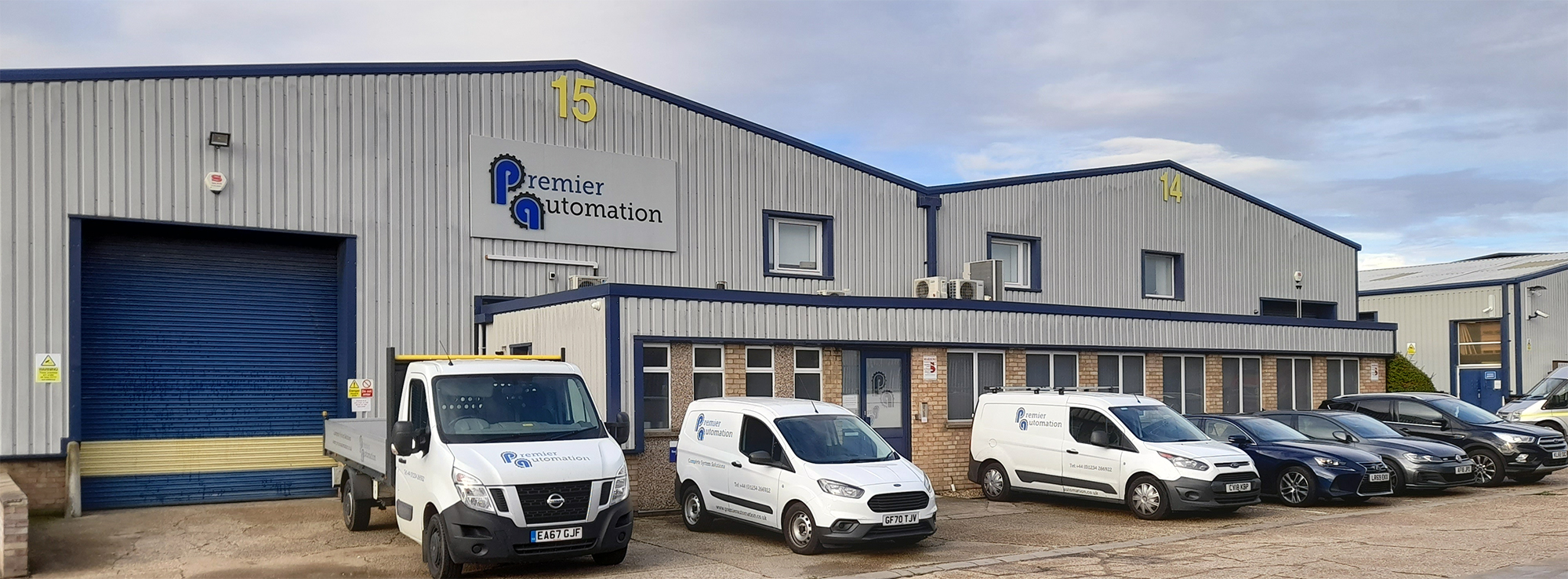
Premier Automation designs and builds robot-based automation and control systems from its substantial local facility, supporting projects across the UK and internationally. Its work covers machine tending, palletising, welding, gluing and gasket dispensing, as well as special-purpose machinery and process-line controls.
Choosing the right Industrial Automation in Bedford solution
Robot selection is not simply a question of payload. Reach, repeatability, speed, mounting position, environmental conditions and end-of-arm tooling all matter. For example, a modestly sized robot with a purpose-designed gripper can often deliver a more reliable machine-tending result than a larger, general-purpose unit. Tooling should accommodate normal variation in components without masking defects that need attention.
Collaborative robots, often called cobots, can be useful where people and automation share a workspace or where product changes are frequent. They are not automatically safer in every application, however. A risk assessment may still require safeguarding, speed limits, force limits or defined operating modes. Conventional industrial robots remain the better fit for many high-speed, heavy-payload and fully enclosed processes.
Existing equipment also deserves careful consideration. Re-engineering a used robot or upgrading an older cell can be cost-effective where the mechanical platform remains sound. New controls, safety hardware, programming and tooling can extend useful life while bringing the operation closer to current production requirements.
Planning Industrial Automation in Bedford from concept to commissioning
A successful project begins with a site review and a realistic understanding of upstream and downstream processes. If a robot is supplied parts inconsistently, or finished goods cannot leave the cell quickly enough, the robot will spend time waiting. Reviewing presentation, conveyors, buffers, changeovers and quality checks early prevents bottlenecks being transferred elsewhere.
Controls integration is equally significant. PLC programming, robot programming, operator interfaces and data exchange should be planned as one system. Clear fault messages, sensible manual recovery routines and accessible maintenance points make a major difference after handover. Where appropriate, production teams can also use status information to identify recurring stops and improve availability.
Safety must be built into the design, not added at the end. The HSE guidance on work equipment and machinery highlights duties under the Provision and Use of Work Equipment Regulations 1998 (PUWER), including ensuring work equipment is suitable, maintained and used by properly trained people. For automated cells, this means considering foreseeable access, setup, cleaning, fault recovery and maintenance alongside normal automatic running.
Integration, support and future flexibility
Installation and commissioning are the point at which design assumptions meet the live factory. A structured approach tests safety functions, confirms cycle times, proves product handling and trains users before production responsibility is handed over. Acceptance criteria should be agreed in advance, including which parts will be run, expected quality standards and the support available during the initial operating period.
Flexibility can be designed in without overcomplicating the project. Quick-change tooling, recipe-driven programmes, adjustable fixtures and spare input/output capacity can support future variants. Equally, keeping an initial system focused can protect budget and make it easier for operators to adopt. The best balance depends on the expected product mix and the confidence of future demand.
Premier Automation provides design, manufacture, installation and commissioning alongside PLC and robot programming, upgrades, relocation and after-sales support. As a Siemens Solution Partner and ABB Value Provider, the team can align robot and control choices with established industrial platforms and the support needs of the site.
Frequently Asked Questions
How long does an automation project take?
Timescales depend on the complexity of the process, equipment lead times, safety requirements and testing needs. A clear initial specification, prompt decisions on sample parts and early site information help keep a project moving efficiently.
Can automation work with existing machinery?
Yes. Robots and new control systems can often be integrated with existing CNC machines, conveyors and process equipment. A survey is needed to assess interfaces, guarding, condition and the practical access needed for operation and maintenance.
Will a robot replace our operators?
Many projects move people away from repetitive, heavy, hot or awkward tasks and into quality, supervision, assembly or higher-value work. The right approach considers both output targets and how the workforce will operate and maintain the new process.
What support is available after installation?
Support can include operator training, fault finding, software changes, preventative maintenance, spare parts advice and future upgrades. Agreeing the required response level before commissioning gives production teams greater confidence.
If you are assessing Industrial Automation in Bedford for a new line, an upgrade or a specific production bottleneck, Premier Automation can discuss the process and develop a practical solution around your requirements.