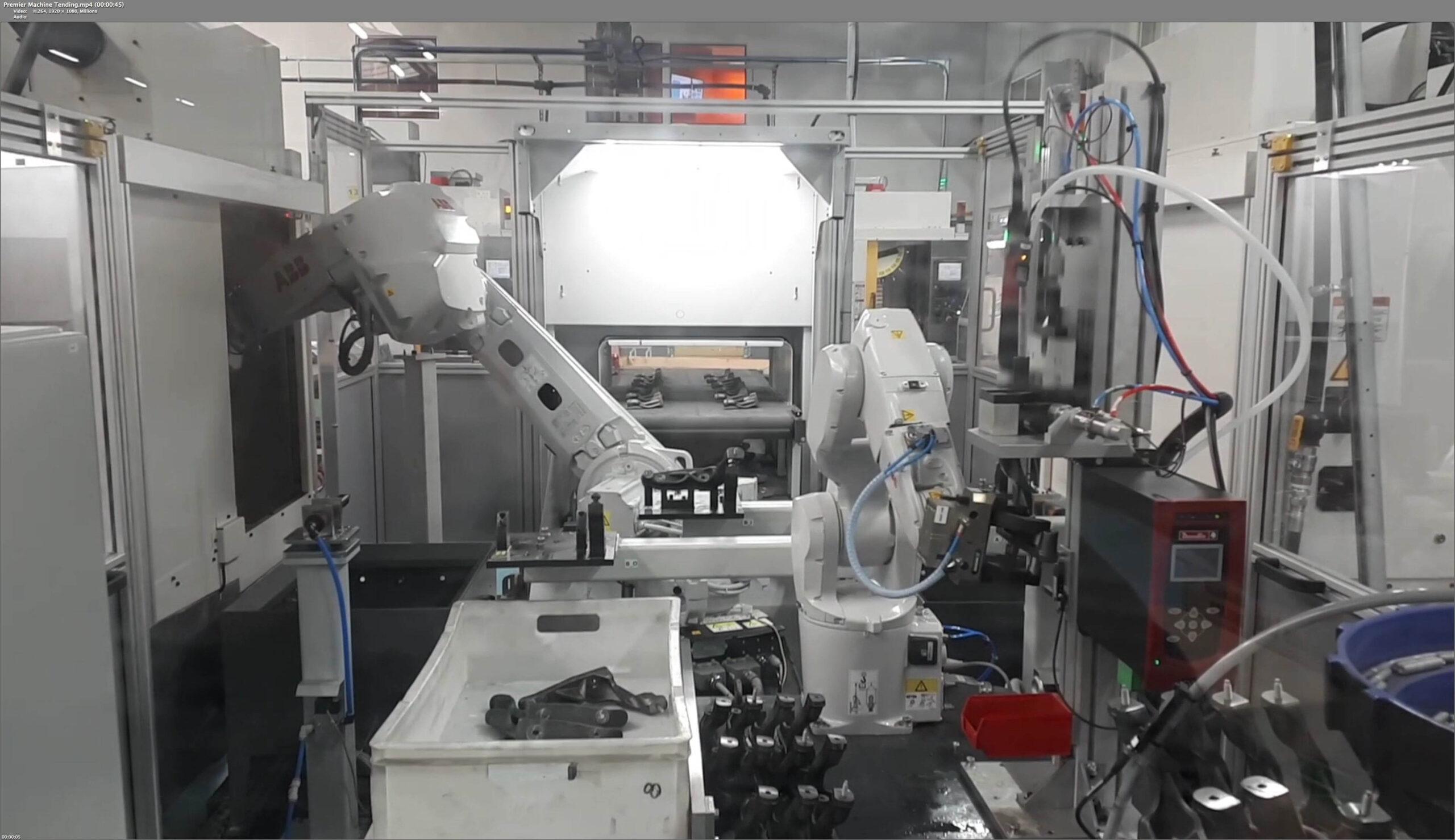
Machine Automation In The UK helps manufacturers improve consistency, protect operators and increase output without relying solely on additional labour. The strongest projects begin with a clear production problem: a repetitive task, a quality variation, an awkward lift or a bottleneck that limits the whole line. From its facility in Bedford, Premier Automation designs systems around those practical needs, from individual robotic cells to integrated process lines.
Automation is not limited to large factories or fully hands-off production. A robot can load and unload a CNC machine, stack finished products, apply adhesive accurately or support welding work while people retain responsibility for inspection, set-up and exceptions. The aim is to make each stage more reliable and easier to manage, while creating a solution that fits the available space, product range and budget.
Where Machine Automation In The UK Delivers Value
The best opportunity is usually a stable, repeatable activity with a measurable cost of delay, inconsistency or manual handling. Machine tending can keep equipment working through breaks and reduce waiting time between cycles. Palletising can create safer, more uniform loads. Welding and dispensing automation can hold a repeatable path, speed and quantity, helping reduce rework and material waste. A successful Machine Automation In The UK project also considers changeovers, part presentation and how operators will safely interact with the cell, rather than focusing on robot speed alone.
Planning Machine Automation In The UK Around Your Process
Before selecting equipment, map the current process in detail. Record cycle times, product sizes, tolerances, batch sizes, stoppages and the number of variations a system must handle. This reveals whether a fixed industrial robot, a collaborative robot, purpose-built tooling or a combination is most suitable. It also prevents a common mistake: automating one operation while leaving an upstream feed or downstream packing task as the new constraint. A short feasibility review can identify the required guarding, fixtures, sensors and controls before capital is committed.
Safety and compliance for Machine Automation In The UK
Safety should be built into the design, not added during commissioning. Risk assessment needs to cover normal running, loading, faults, cleaning, maintenance and recovery after a stoppage. The HSE machinery safety guidance on the Provision and Use of Work Equipment Regulations 1998 (PUWER) explains that work equipment must be suitable, maintained and inspected where necessary. In practice, that may mean interlocked guarding, emergency stops, safe access points and clear lock-off procedures. A collaborative robot is not automatically safe without guarding; its application, tool, payload and movement all require assessment.
Choosing the right robot and controls
Industrial robots suit demanding, fast or heavy-duty work, while cobots can be useful where people and automation share a workspace and production changes regularly. The end-of-arm tool is equally significant: a gripper, vacuum cup, welding torch or dispensing head must reliably handle real components, including tolerances and surface variation. Controls should also be chosen with future support in mind. A well-structured PLC and robot program makes fault finding, product changes and later expansion considerably simpler than a system built only for the first production run.
A practical implementation route
A robust project typically moves from site assessment and concept design to detailed engineering, build, testing, installation and commissioning. Factory testing before delivery gives the customer an opportunity to see sequence logic, safety functions and representative parts in operation. During installation, plan for utilities, access, operator training and a realistic handover period. Existing robots can sometimes be re-engineered, upgraded or relocated instead of replaced, which may offer a sensible route where the mechanical condition is sound but controls, guarding or programming no longer meet operational needs.
Frequently Asked Questions
How long does an automation project take?
Timescales depend on complexity, tooling, safety measures and product testing. A defined, repeatable application moves faster than a line with many product variants or substantial building changes.
Will automation replace our operators?
Often, it reallocates people from repetitive or physically demanding tasks to inspection, machine supervision, assembly and higher-value work. Training helps teams use the new system confidently.
Can automation handle small production batches?
Yes. Flexible fixtures, recipe-driven controls and suitable grippers can make short runs practical. The key is balancing changeover time against the expected volume and labour saving.
What support is needed after installation?
Routine maintenance, spare-part planning and access to programming support help protect availability. Keep operating instructions and safe recovery procedures accessible for trained users.
For a considered route to Machine Automation In The UK, Premier Automation can support feasibility, system design, build, installation, programming and ongoing service for new or upgraded robotic systems.