Palletising Robot Systems In The UK for Faster, Safer and More Flexible Production
For manufacturers handling boxed, bagged, or wrapped products, Palletising Robot Systems In The UK are becoming a practical way to improve throughput, reduce manual handling, and create more consistent pallet loads. Whether you are moving goods at the end of a packing line or looking to modernise an existing cell, Premier Automation provides honest, technically sound solutions built around your process, budget, and expected return on investment.
Why businesses are investing in Palletising Robot Systems In The UK
Palletising is one of the most repetitive tasks in a factory or distribution setting. It often involves heavy lifting, awkward movements, and constant pressure to keep up with production. A well-designed robotic palletising system can take over this part of the process with reliable, repeatable performance.
The benefits are clear. Robots can maintain a steady cycle time, stack products accurately, and reduce the risk of damaged loads. They also help improve workplace safety by limiting manual lifting and repetitive strain. For businesses dealing with labour shortages or rising output demands, automation can provide a more dependable long-term solution.
Premier Automation works with customers to assess whether palletising automation is the right fit, rather than pushing a system where it is not suitable. That practical approach matters, especially when every production line has its own constraints, products, and commercial targets.
What makes a palletising system effective
A successful palletising cell is not just about adding a robot arm. The full solution needs to match the product, the speed of the line, the available floor space, and the downstream requirements. That includes everything from gripper design and conveyor layout to safety measures, controls, and operator usability.
Premier Automation designs and builds complete automation systems with the control system at the centre. Its engineering team develops schematics, panel layouts, cable schedules, safety reports, and risk assessments to make sure the finished installation performs properly and complies with relevant standards. For general machinery safety guidance, manufacturers can also refer to the HSE machinery safety resource.
Because every site is different, flexibility is vital. Some operations need a basic single-line palletising cell, while others require twin pallet positions, multiple infeeds, or integration with equipment such as stretch wrappers. In many cases, the best answer is a system that can grow with the business rather than one built only for current output.
Choosing between standard and bespoke Palletising Robot Systems In The UK
There is no single model that suits every application. Some businesses benefit from a standardised cell that can be installed quickly and moved easily in the future. Others need a bespoke system tailored to unusual pack formats, special tooling requirements, or site-specific layouts.
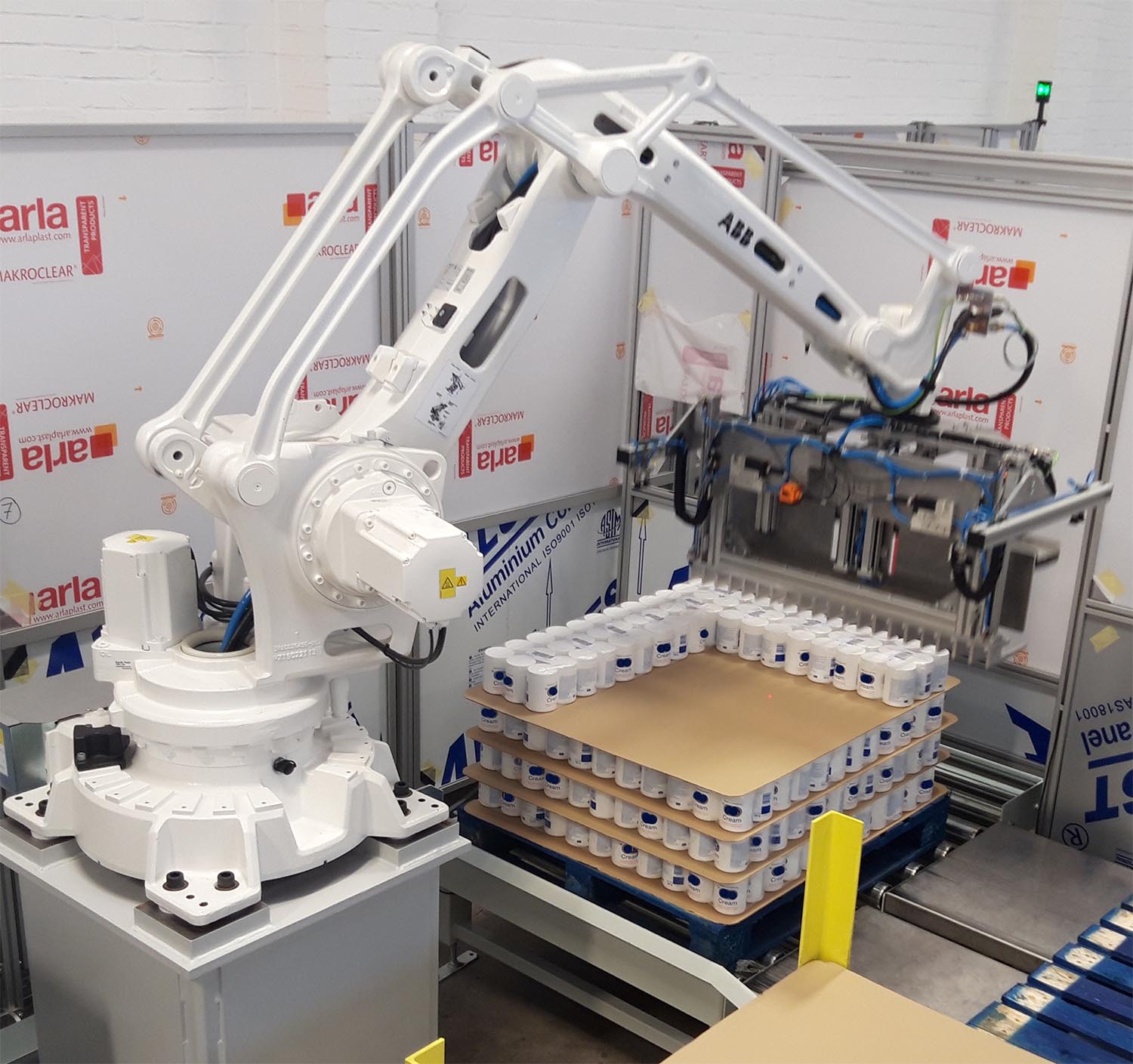
Premier Automation offers both approaches. Its experience includes compact palletising cells based around ABB palletising robots, twin palletising systems for greater throughput, and cobot palletising cells where flexibility and ease of programming are important. The company also has in-house machining and fabrication capabilities, which means custom pedestals, support frames, guarding, and tooling can be produced without relying entirely on outside suppliers.
This matters when a system needs to cope with changing products or future line modifications. A bespoke gripper, adjusted software, or revised conveyor arrangement can make the difference between a system that quickly becomes restrictive and one that continues delivering value for years.
Upgrading existing lines without starting from scratch
Not every business needs a completely new cell. In some cases, the most cost-effective answer is to re-engineer an existing installation. Older robot systems can often be updated to improve cycle times, accommodate new products, or restore lost performance. Existing robots may also be reused in a new cell, helping control capital costs.
Premier Automation supports system assessments, upgrades, relocation projects, and control system improvements for both its own installations and systems integrated by others. That gives customers more options when they want better performance without replacing everything on the line.
The company can also relocate automation equipment within an existing factory, to another site in the country, or overseas if needed. From its facility in Bedford, Premier Automation supports customers across a wide range of industries, helping them protect previous investment while improving efficiency and reliability.
Why Palletising Robot Systems In The UK need strong controls and support
The robot may be the most visible part of the cell, but the controls, software, and after-sales support are just as important. Reliable automation depends on well-built panels, clear user interfaces, accurate programming, and a commissioning process that tests every input, output, and safety function before production begins.
Premier Automation designs and manufactures control systems for robots, special purpose machinery, and process lines, with in-house build, installation, and commissioning support. Its engineers also provide robot and PLC programming, including off-line development using digital tools to reduce downtime during installation or modification work.
As a Siemens Solution Partner and ABB Value Provider, Premier Automation brings recognised technical capability to robot integration projects. Businesses researching wider industry developments can also explore the work of BARA, the British Automation & Robot Association.
Planning Palletising Robot Systems In The UK around commercial return
The right automation project should make technical sense and commercial sense. That means looking at labour savings, output improvement, product consistency, maintenance needs, and the level of flexibility required for future production. It also means choosing an integration partner that will give straightforward advice rather than forcing a one-size-fits-all design.
Founded in 2000, Premier Automation has built a strong reputation for robot integration, control systems, upgrades, and support across multiple industrial applications. If you are reviewing end-of-line handling, replacing manual palletising, or adapting an existing robotic cell, Premier Automation can help you identify a practical solution that meets your process requirements and payback criteria.