
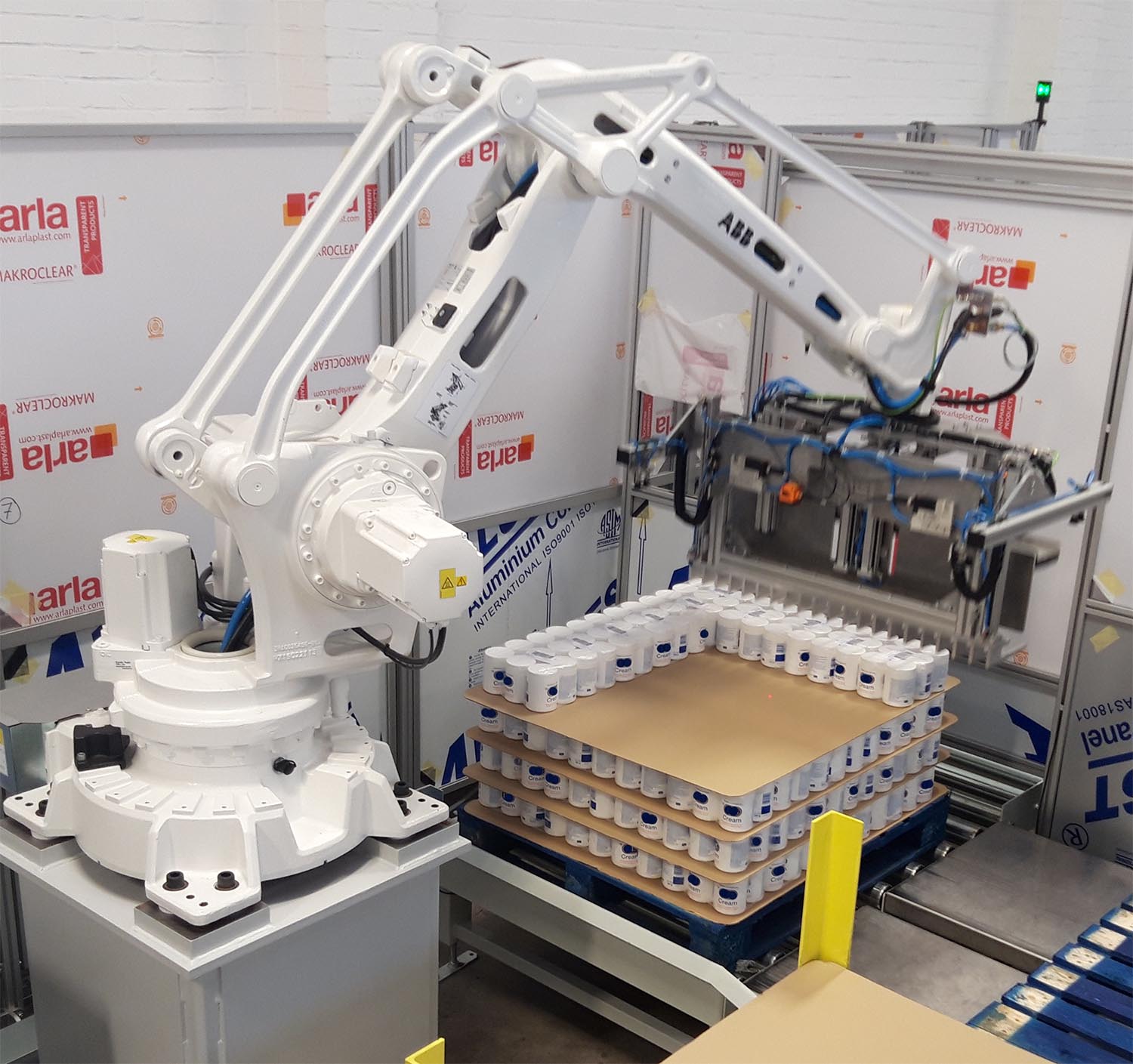
Palletising Robots In The UK are helping manufacturers, warehouses and food producers move finished goods faster, more consistently and with less manual handling. Rather than replacing a well-run operation overnight, the right robotic cell addresses a defined end-of-line task: picking cases, bags, trays or containers and building stable pallets ready for storage or dispatch. A carefully designed system can improve output while giving staff more scope to focus on quality, exceptions and higher-value work.
The best starting point is to understand the products, pallet patterns and production targets that matter to your business. Palletising is not simply a question of robot speed. Case condition, load stability, changeover frequency, available floor space and upstream reliability all influence whether a solution delivers dependable results.
Why Palletising Robots In The UK Are Becoming a Practical Choice
Manual palletising can be physically demanding, especially where shifts are long, loads are repetitive or products need to be stacked at height. A robot can repeat the same programmed movement throughout a shift, helping to maintain pallet quality and reducing exposure to routine lifting and twisting. This can be particularly useful for operations managing seasonal peaks or labour shortages.
Consistency also supports smoother logistics. A robot can place products to a defined pattern, maintain interlocking layers and apply the correct orientation for each pack type. Neater, more stable loads can reduce damage during transport and make better use of pallet and vehicle space. For businesses comparing Palletising Robots In The UK, these downstream gains are often as valuable as the direct labour saving.
Robotic systems can suit a wide range of applications, from a single production line to several lines feeding one cell. Depending on the product, the end effector may use vacuum, mechanical gripping, forks or a custom tool. The choice should be based on real packs and pallets, not catalogue dimensions alone; dusty cardboard, open trays, flexible bags and cold-room conditions each create different handling requirements.
Choosing Palletising Robots In The UK for Your Product Mix
Start by recording the full operating picture. This includes case dimensions and weights, pallet sizes, layer patterns, required throughput, line speed and the number of stock-keeping units. Include the awkward situations too: damaged cases, partially filled pallets, slip sheets, corner boards and the process for a product change. These details allow the cell to be designed for everyday production rather than an idealised demonstration.
Reach and payload are only part of robot selection. The robot must have enough capacity for the product and gripper together, with a suitable margin for the intended duty. Cycle time should also allow for pallet exchange, product accumulation and any wrap, label or quality-check stages. A buffer conveyor or pallet dispenser can prevent short stops from turning into lost production time.
Floor layout deserves early attention. A compact cell may fit into an existing line, but it still needs access for replenishing pallets, clearing faults and carrying out maintenance. Allowing sensible access from the outset is usually more economical than altering guarding, conveyors or services after installation. At its facility in Bedford, Premier Automation can develop systems around the available space and the practical needs of the people who will operate them.
Implementing Palletising Robots In The UK with Minimal Disruption
A successful project begins with a clear scope and representative trials where appropriate. Providing samples of every case type, pallet and layer material helps identify grip, stack and transfer issues early. It is also useful to agree acceptance criteria before build, such as target output, permitted changeover time, pallet presentation and how the system handles planned stops.
Integration is central to performance. The palletiser needs reliable signals from upstream equipment and a clear method of controlling product flow when a pallet is full or a fault occurs. Controls programming should communicate status in a way that operators can understand quickly, rather than leaving them to interpret technical alarms. Recipes for different products should be straightforward to select, with controlled access to settings that affect safety or stack quality.
Installation planning can reduce avoidable downtime. Many businesses choose to complete as much assembly, programming and testing off site as possible, then schedule final installation around a quieter production period. Training should cover normal running, safe recovery, changeovers, daily checks and escalation routes, giving operators confidence from the first shift.
Safety, Compliance and Long-Term Support
Robot cells require a risk assessment that considers the complete system, including infeed and outfeed conveyors, pallet handling and access during clearing or maintenance. The HSE explains that the Provision and Use of Work Equipment Regulations 1998 (PUWER) require work equipment to be suitable, maintained and used only by people with adequate information, instruction and training. Guarding, interlocks, emergency stops and safe isolation arrangements must be designed around the actual task.
Safety should not make the cell difficult to run. Well-positioned controls, clear fault messages and properly considered access points help staff resolve routine issues without bypassing protective measures. Regular inspection of grippers, sensors, vacuum components and conveyor interfaces also protects uptime. Keep spare parts and support arrangements in mind before commissioning, particularly for multi-shift operations.
A modular approach can provide room for future growth. Extra pallet positions, another infeed, new gripper tooling or revised programming may be possible as product ranges change. This is why the original design should consider likely expansion, even if the first installation is deliberately simple.
Frequently Asked Questions
What products can a palletising robot handle?
Robots can handle many cases, cartons, trays, bags, tubs and shrink-wrapped packs. Suitability depends on product weight, surface, rigidity, dimensions and the required pallet pattern. A sample assessment helps determine the most reliable gripper and cell layout.
How much space does a robotic palletising cell need?
Space varies with robot reach, guarding, conveyors, pallet storage and operator access. A site survey should assess both the footprint and the room needed to load pallets, clear faults and maintain equipment safely.
Can one robot palletise different products?
Yes. A robot can run programmed recipes for multiple products and pallet patterns, provided the gripper and cell are designed for the range. Changeover arrangements should be tested for speed and simplicity before the system is specified.
Will a robot stop the line if there is a fault?
It can, but good design limits the effect. Product buffering, clear alarms and defined recovery procedures can help operators address minor interruptions promptly while protecting the quality and safety of the process.
Palletising Robots In The UK can be a measured investment in safer handling, steadier output and better dispatch quality. Whether you need a new cell, a used robot integration, controls upgrade or support for an existing installation, Premier Automation can help you assess the application and plan a solution that fits your operation.