What are the benefits of Automated Palletising for modern manufacturers?
What are the benefits of Automated Palletising for businesses that need faster, safer and more reliable end-of-line handling? For many manufacturers, warehouses and production facilities, palletising is one of the most repetitive and physically demanding parts of the process. It is also an area where delays, inconsistent stacking, manual handling risks and labour shortages can quickly affect output. Automated palletising offers a practical way to improve productivity while creating a more controlled and consistent operation.
Premier Automation designs, builds, integrates and upgrades robot systems for a wide range of industrial applications. From new robotic palletising cells to re-engineered systems and control upgrades, the aim is always to provide a solution that fits the customer’s process, product range, available space and commercial payback criteria.
What are the benefits of Automated Palletising for production efficiency?
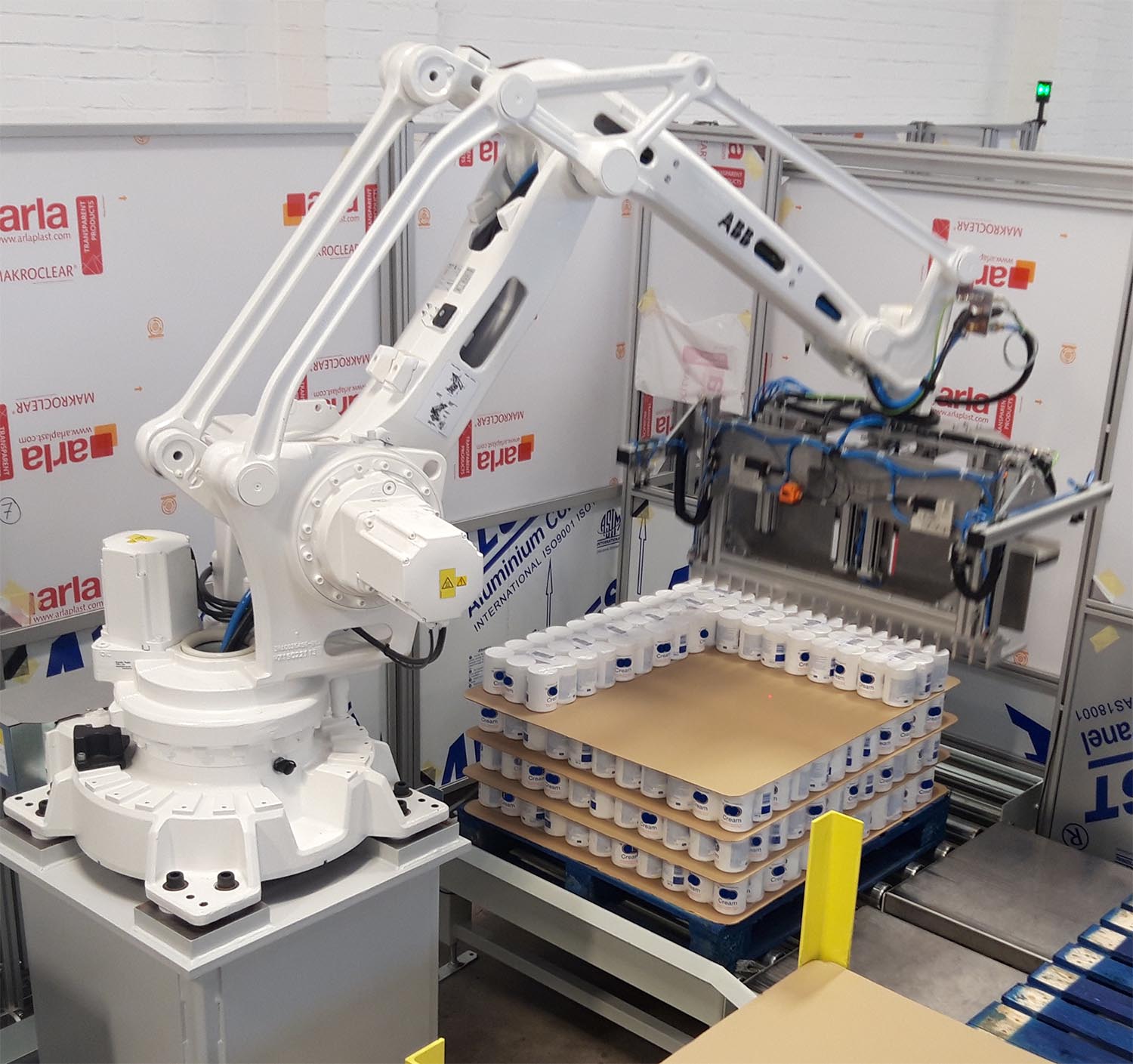
One of the biggest advantages of automated palletising is its ability to keep production moving at a consistent pace. Manual palletising depends on operator availability, shift patterns, fatigue and the physical demands of lifting, turning and stacking products. A robotic palletising system can repeat the same task accurately for long periods, helping to reduce bottlenecks at the end of the line.
For businesses handling cartons, bags, trays, containers or other packaged goods, this can make a significant difference. Products can be picked, positioned and stacked in a pre-set pattern, helping to create stable pallet loads ready for storage, wrapping or transport. Systems can also be designed around single or multiple infeed conveyors, twin pallet positions, pallet conveyors and integration with downstream equipment such as stretch wrappers.
Premier Automation has experience designing robotic palletising systems for different product types and production layouts, including standard palletising cells, twin palletising cells and cobot palletising cells. This allows manufacturers to choose a system that suits both current production needs and future growth.
Improved safety and reduced manual handling
Manual palletising can place significant strain on workers, especially where products are heavy, awkward, repetitive or stacked throughout a full shift. Over time, these tasks can contribute to fatigue, discomfort and workplace injury. By automating the lifting, turning and stacking process, businesses can reduce the amount of repetitive manual handling required from their team.
This does not remove the need for people. Instead, it allows operators to focus on supervision, quality checks, line management and higher-value tasks. A well-designed automated system can support a safer and more efficient working environment, particularly when combined with appropriate guarding, risk assessments and compliant control systems.
Machinery safety should always be planned carefully. The HSE guidance on work equipment and machinery provides useful information for businesses that need to understand their responsibilities around safe equipment use. Premier Automation supports this through detailed design, control systems, safety reports and careful project management.
What are the benefits of Automated Palletising for product consistency?
Consistent pallet quality matters. Poorly stacked pallets can create problems in storage, transport and handling. They may be more likely to shift, collapse, damage products or slow down loading processes. Automated palletising helps reduce these risks by placing each item in a repeatable position, following a defined pallet pattern every time.
This is especially valuable for businesses with regular product sizes, high-volume lines or strict customer delivery standards. Robots can be programmed to build stable, uniform loads that make better use of pallet space and improve presentation. Where product ranges vary, systems can often be configured to handle different formats, provided the gripper design, feed system and control logic are planned correctly.
Premier Automation has designed special grippers for many different products. This is a key part of making palletising automation work properly, as the gripper must handle the product securely without causing damage. The right tooling, combined with accurate programming and a robust control system, helps achieve reliable performance across repeated cycles.
Lower labour pressure and better use of staff
Many businesses are under pressure to increase output while dealing with recruitment challenges, rising labour costs and the need to keep experienced staff focused on skilled work. Automated palletising can help by taking over a task that is necessary but repetitive. This can make staffing easier to manage, particularly on high-output lines or during peak production periods.
Rather than relying on manual palletising throughout the day, operators can oversee the system, manage pallet changes, monitor quality and support other parts of the production process. This can improve morale as well as productivity, because employees are not tied to physically demanding work for long periods.
What are the benefits of Automated Palletising for businesses with limited space or changing production needs? In many cases, the answer is flexibility. Robotic and cobot palletising systems can be designed around the available footprint, product flow and pallet positions. Some cells can also be built on fabricated base frames, making installation or future relocation more straightforward.
What are the benefits of Automated Palletising when products change?
Production requirements rarely stay the same forever. Packaging changes, new products are introduced, throughput targets increase and factories are reorganised. A major benefit of robotic palletising is that systems can often be modified, upgraded or reprogrammed to support new requirements.
Premier Automation works with new robot systems, used robots and existing automated systems. This means a business does not always need to start again from scratch. Existing robot systems can be re-engineered to work more efficiently, reduce cycle times or handle new products. For companies that already have automation in place, this can be a cost-effective way to improve performance and extend the value of existing equipment.
The company also provides robot and PLC programming support, including offline programming and digital twin work where suitable. This can help reduce disruption by allowing changes to be developed and tested before work is carried out on the live production line.
Supporting long-term payback and reliable performance
Automation should be commercially sensible as well as technically impressive. A palletising system needs to match the customer’s production volume, product type, available space, safety requirements and expected return on investment. This is why early assessment and honest advice are so important.
Premier Automation operates from a large facility in Bedford and supports customers locally, nationally and internationally. The team designs and builds control systems, manufactures panels in-house, provides installation and commissioning, and supports customers after installation. This joined-up approach helps create systems that are practical to operate, maintain and adapt.
For businesses considering automation for the first time, industry bodies such as the British Automation & Robot Association can also be useful for understanding the wider role of robotics and automation in UK manufacturing. However, the most important step is to assess the specific process, product and operational goals before choosing a solution.
What are the benefits of Automated Palletising for your business?
The main benefits include faster end-of-line handling, safer working practices, reduced manual handling, more consistent pallet loads, better use of labour and improved long-term productivity. For some businesses, the greatest value comes from reducing bottlenecks. For others, it may be improving safety, increasing output, reducing product damage or creating a system that can run with less supervision.
What are the benefits of Automated Palletising will depend on your production environment, but the right system can make a measurable difference to daily operations. Whether you need a new robotic palletising cell, a cobot palletising solution, a system upgrade, new controls, programming support or relocation of existing automation, Premier Automation can provide practical guidance based on your process and payback criteria.
If your business is reviewing its end-of-line handling, Premier Automation can help assess the options and design a cost-effective automated solution that supports safer, faster and more reliable palletising.